There are new mixed media sculptures in your Blue Acid show. They combine 3D elements with 2D painted planes which are almost billboard-like presentations intermixed in the work in a novel way. How do you approach such a thing?
One of the great things about making art is discovering something that sprang from seemingly nowhere. In retrospect it looks logical but in the moment it’s an epiphany and suddenly it’s exciting to explore it. My studio is across the street from Creative Woodworking and they have a box where they put scrap wood for anyone who wants it and it’s irresistible to me and there were a bunch of oddly shaped things with multiple sides so I painted on them realizing that different themes could coexist depending on which side and that led to adding sculptural elements and words and basically opened a new horizon for me.
You’ve been making art for a long time. Have you always sculpted as part of your process?
Like most artists, we are compelled to make things. When I was a cub scout we were making dioramas and I made a swamp with frogs and turtles and it seemed real to me I could barely sleep because I was imagining it and to this day sculpture has that affect on me. I restrain myself and keep it a supplement to painting which I’ve spent a lifetime trying to get good at but sculpture always whispers to me.
There are new mixed media sculptures in your Blue Acid show. They combine 3D elements with 2D painted planes which are almost billboard-like presentations intermixed in the work in a novel way. How do you approach such a thing?
One of the great things about making art is discovering something that sprang from seemingly nowhere. In retrospect it looks logical but in the moment it’s an epiphany and suddenly it’s exciting to explore it. My studio is across the street from Creative Woodworking and they have a box where they put scrap wood for anyone who wants it and it’s irresistible to me and there were a bunch of oddly shaped things with multiple sides so I painted on them realizing that different themes could coexist depending on which side and that led to adding sculptural elements and words and basically opened a new horizon for me.
One of the great things about making art is discovering something that sprang from seemingly nowhere.
You’ve been making art for a long time. Have you always sculpted as part of your process?
Like most artists, we are compelled to make things. When I was a cub scout we were making dioramas and I made a swamp with frogs and turtles and it seemed real to me I could barely sleep because I was imagining it and to this day sculpture has that affect on me. I restrain myself and keep it a supplement to painting which I’ve spent a lifetime trying to get good at but sculpture always whispers to me.
Do these new sculptures inform or change the way that you approach your oil and acrylic paintings?
It’s very easy to get in a rut and replicate things that work and I’ve discovered that shaking up the process is necessary and in my case with time running out for my big solo show Blue Acid I decided to do some sculptures which my wife thought was a dubious time management idea. However when I’m under pressure I get more creative and suddenly ideas come in my dreams and I wake up with something new and the excitement generates energy and enthusiasm and my paintings get better.
While there’s always a ton of realistic details in your work, the “artist’s hand” is evident in your painterly brush strokes. Because of this approach, many of your paintings have a slightly blurred or “in motion” feel to them, like a freeze frame of a movie…
I’ve never been a fan of hyperrealism because it excludes the viewer who needs to have room for their imagination to interpret. Sometimes a few brush strokes can imply bricks instead of rendering each one so the blur helps also there’s a concept of a rest place in a painting where the viewer can pause before resuming their journey through the painting anyway think how long movies would need to be without our imagination doing the work.


 Bendt Eyckermans offers paintings in mid-narrative, often based on an actual event or memory in his life. Yet, as our mind often does, the result of recreating those situations is both distorting and delicate. Recent paintings by the artist were showcased in a show at Carlos/Ishikawa in London.
 Vincent Castiglia, an artist who exclusively uses human blood to craft his dark-surrealist paintings, is the focus of a new show at Dark Art Emporium Gallery in Long Beach. "Autopsy of the Soul" offers both new works and a retrospective of the artist, who’s also been commissioned by patrons such as Gregg Allman, Gary Holt of Slayer, and Margaret Cho (using their blood, instead of his). The show begins on June 8.
 HF Vol. 21 artist Katsuyo Aoki is perhaps best known for her intricate, pure white porcelain skulls, covered here. Her latest sculptures are decorated with colorful designs, some of which are now on display in "The Colors of Globalization" at Bernardaud Foundation in Paris. It was Victorian England that kicked off the trade of blue and white porcelain originally. Aoki's palette draws upon this time period, which dates back to 18th century designs that imitated Chinese porcelain.
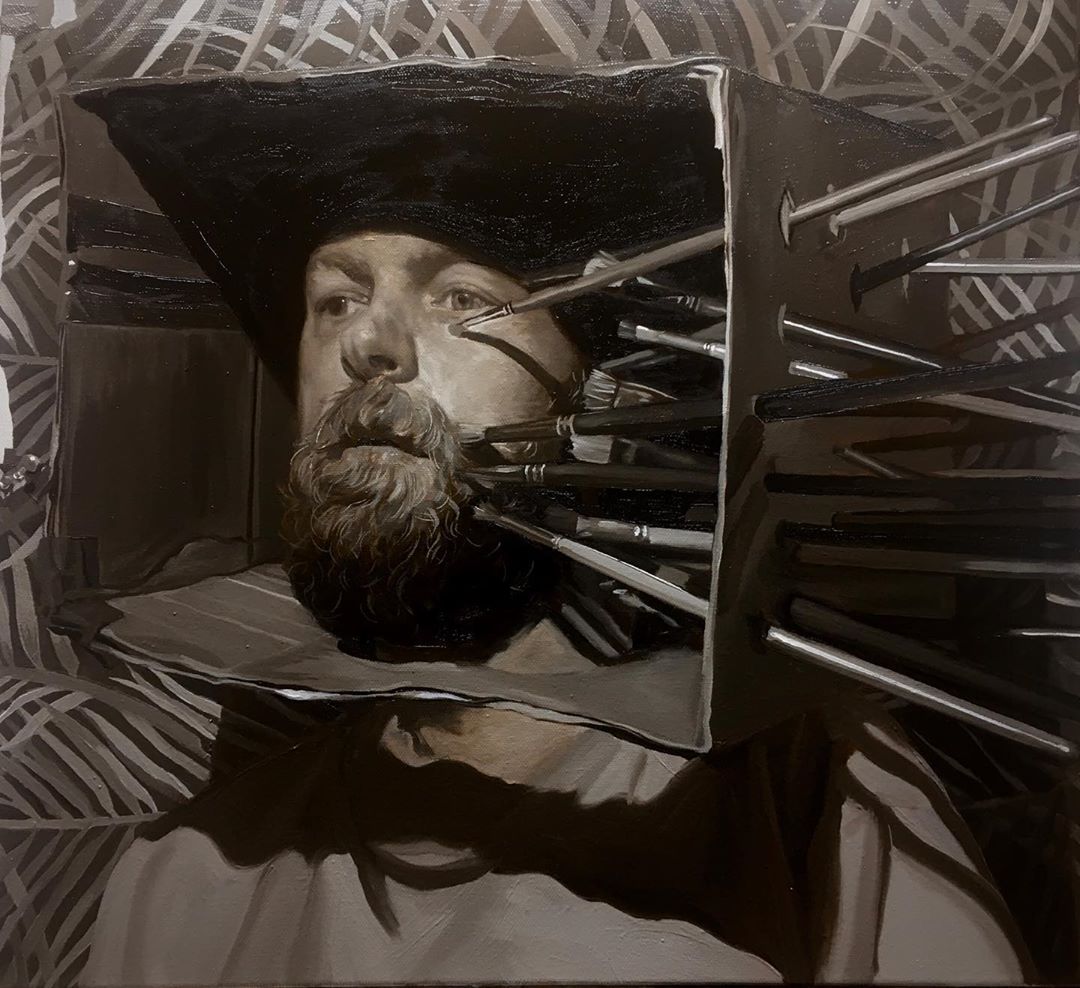 Oil painter and performance artist John Robinson crafts cerebral, wistful, and, at times, humorous self-portraits. His works, often rendered in monochromatic tones, sees the artist donning masks and contraptions that speaks to his current reflections. Elsewhere, he re-imagines moments of art history through his distinct filter.
 Working out of her Austin studio,
 Barcelona, Spain based artist


