


Benjamin Spiers Paints Disconcerting Surrealism For the Modern Age
“I have a hunch that any successful painting creates work for the viewer,” says the painter Ben Spiers. “I think that’s part of the reason why it can be hard to begin the process of looking at paintings seriously. There can be a lot of impatience one feels for the first few minutes of being in a museum.” Spiers’s paintings leave viewers a lot of work to do in processing, considering, deciding what to make of it all. The odd angles. Intermingling the grotesque and the erotic. Muted colors, nuclear hot colors.
Darkness and light.
Concealment and ecstatic revelation.
“I often think of painting as a very complex and elaborate game of hide and seek,” he says. And what’s being sought, ultimately, is empathy. Spiers can’t follow through on a work if he doesn’t feel that connection. A thread between himself and the figure, their story.
The “story” in his paintings is typically a moment where the figure is becoming. The instance of transformation. Transmutation. The big feelings. Joy, sorrow, anger, acceptance, exaltation. What happened before and what comes after is of very little importance. What are our memories but a library of when we felt enormously? Sure, context and whys matter, but just matter less. The biggest difference between being a human and an animal is our capacity to feel these kind of emotions. And to record them. As Spiers does with complex precision.
Spiers says, “I’ve always been very interested in the way softness and toughness mingle. The carapace and the vulnerable stuff beneath. I don’t regard a painting of mine as a success if I struggle to empathize with the character I’ve created.”
The vast majority of his figures are composites. Inspiration snags onto him and can’t let him go and he can’t let it go either. The inspiration and the artist become preoccupied with each other. This could be a hand he sees in a photograph, an advertisement, a carving in a Gothic cathedral that he happens through on a lark. But he knows it when it happens. Not just because it has happened so many times, being inspired. Sometimes this kernel of inspiration takes years to flourish. The time between the kernel snagging him and its flourishing is spent in contemplation, in drafts, in collage, but he lets the idea guide its own evolution. The last thing he wants to do is get in the way.
The only guiding rule, however, is that there must be a problem to solve. Some kind of insane musculature to create. An emotion to capture just so.
“If I’m just copying a resolved image then the painting will be inert. There will be no opportunity to embed pockets of psychic energy into the painting,” he says, “that is plain sailing—no sturm und drang—and where is the fun in that?”
I OFTEN THINK OF PAINTING AS A VERY COMPLEX AND ELABORATE GAME OF HIDE AND SEEK.”

The figures are almost without exception composites. Memories, historical sources, his own vivid imagination might inform the end product. Spiers is a true scavenger (meant in the best and most complimentary way).
His own body helps in the act of creation. He practices the poses himself. If you’re looking at a painting of his then you can imagine himself trying out the composition in real life. The angle of a leg, an arm. And especially the hands.
A recent painting, however, took a different direction. One work from his recent stay in Venice, called “The Sorcerer,” is a true portrait. The figure is based on an ex-girlfriend. A Russian model, perfumier, aerial performer. And here we clue into her closed eyes, the outstretched hand, and there is a sense to it when Spiers explains that this painting helped him make sense of the relationship they shared. He says more portraits of this kind are possible.
The female form is incredibly important to Spiers’ work. The pure aesthetic, the history of the must in Western art. He self-proclaims to have always been obsessed with women and, especially, the world of women.
I’VE ALWAYS BEEN VERY INTERESTED IN THE WAY SOFTNESS AND TOUGHNESS MINGLE. THE CARAPACE AND THE VULNERABLE STUFF BENEATH.”
Spiers says, “As a child I was never happier than spending time with my mother. I loved the way she thought about things; the way she looked, moved, dressed, and talked. Seeing her and female friends talking together was infinitely more fascinating than watching my father and his friends. The male world held almost no interest for me. Theirs was a grey-brown fog of boredom and old-fashionedness. Tediously serious. Women seemed ironic, playful, rainbow coloured and—crucially—empathetic.”
And in “The Sorcerer” we see another important aspect of his work. The cat’s face manifesting at bottom left. You will see some animals that are more literally created, some that are highly manipulated. Animals are supporting characters in Spiers’s work. A way to augment their story, a tributary of the empathy he pours into the work.
There is the odd painting where they are centered, such as the plummeting heron in “Wings Outspread” or the fuzzy kitten in “Memories of Rome.” But today animals become a way for the human figures to channel or address their baser instincts. Such as the mask that the figure wears in “Sad Lion.” Or the stretching tabby in “Lovers Under a Green Moon.” In that latter piece the arc of the cat’s back would just fill the negative space under the pale figure.


ABOVE, RIGHT: Portrait photo of Benjamin Spiers, photo by Justin Piperger
Figuring out how to give a logic to his figures is a part of the work that Spiers savors. The exaggerated limbs, the exploded anatomy. The musculature that can appear ballooning in a bicep but taught as piano wire at the tendons. It serves to reinforce this moment of transformation that the figure is experiencing, that we experience vicariously.
Spiers says, “Often I’m thinking about the problem of articulating a surface in such a way that it forces the eye to move over the painting in a particular way. The eye can get blocked at junctions: elbows, knees, ankles, etc. So I look for paths that run across the form in order to connect them. I often deviate from anatomical accuracy in order to generate compositional tension. There are also details that command the eye with psycho(sexual)
compulsion: lips, ears, nipples, fingertips, eyes etc. I will use the bulges and indentations of musculature as an inflection point to modulate the impact of those signifiers.”
His process is a mix of staying true to the initial inspiration as described above and leaving room for improvisation. There is a danger in letting improvisation take hold. It is required for a work to feel fresh. To avoid, as he has described, tediousness. Too much improvisation and the work loses specificity. Too little and it becomes academic.
He cites his 2024 work “The Sunbather.” It started with a clear idea. The dollish quality of the face. The arms and length of the arms, the angle at the hips. But it took him a lot of work to reach the result. Figuring out the chest, the next, the belly. Working with the anatomy, his taste, lots of trial and error.
He says, “I think leaving just the right amount of room for improvisation is something I’m getting better at. Too little and my solutions become pedestrian, too much and there is a danger of breaking the thread of believability that ties the viewer to the work.”
Spiers is hesitant to speculate much over the inspirations and references that go into his work. Much of what we see that leaves his studio has been combed through, combined, re-combined, and filtered based on his particular instincts and taste.
However, it’s hard to look at his work and not see it in conversation with Modernism and the Surrealists. A particularly weighty inflection point in terms of culture and history. A time when the world short-circuited, and a new order began. The impossible made real such that it all seems mundane and quaint from our perspective. A world at war, a world at peace, economic upheaval, a popular yearning for change.
For Spiers, the Modernists inspire making connections. Speculation, confrontation, being at ease with ambiguity. The tension between the resolved and the unresolved, and the hard work to make that dissonance part of the overall work without turning sour.
“I love the challenge of superimposing logic, order, and resolution over a proposition that seems to reject the rational and systematic. Maybe it’s this attempt at unifying contradictory forces that helps create the dynamic of tension and release that animates my work,” he says.
I DON’T REGARD A PAINTING OF MINE AS A SUCCESS IF I STRUGGLE TO EMPATHIZE WITH THE CHARACTER I’VE CREATED.”
But it’s not just the Modernists. His influences span Tarantino, David Lynch, Sonic Youth, Caravaggio, English Classical, American jazz, Derek Jarmen, Steven Spielberg.
He recalls David Lynch’s The Elephant Man—a viewing in his ancient youth. How he was inconsolable after watching the tragedy of Joseph Merrick. From that he learned something about form and content. The complex and contradictory relationship between the two. The power of counterpoint. How to use it to achieve balance. He brings up David Cronenberg’s Existenz. The way the film shows landscape, buildings, and bodies bleed into each other. The dissolution of apartness and the elimination of differences.
“Making connections is the viewers’ job,” he says. “It’s hard work and we shy away from that. But once we have surrendered to the task, we expand and become part of something larger.” *
This article originally appeared in Hi-Fructose Issue 73. The full issue is available here in print!


Tattoo artist, painter, and sculptor Fred Laverne has a dark surrealist sensibility, blending in odes to pop culture and pulp tropes into his work. The artist resides in Menton, France, and has garnered a reputation in both tattooing and fine arts, practices he keeps in parallel.
 With every new body of work that Tara McPherson (HF Collected Edition 3) creates, there is a common theme and evolution to the next. Her upcoming show at Dorothy Circus gallery, "I Know It By Heart," carries on her exploration of ethereal imagery - portraits of young girls caught in a magical moment, but not without also recognizing the negative forces in nature. These include allusions to disease, destruction, and deterioration. There is a balance between what is visually beautiful and, possibly, emotionally discomforting for the artist.
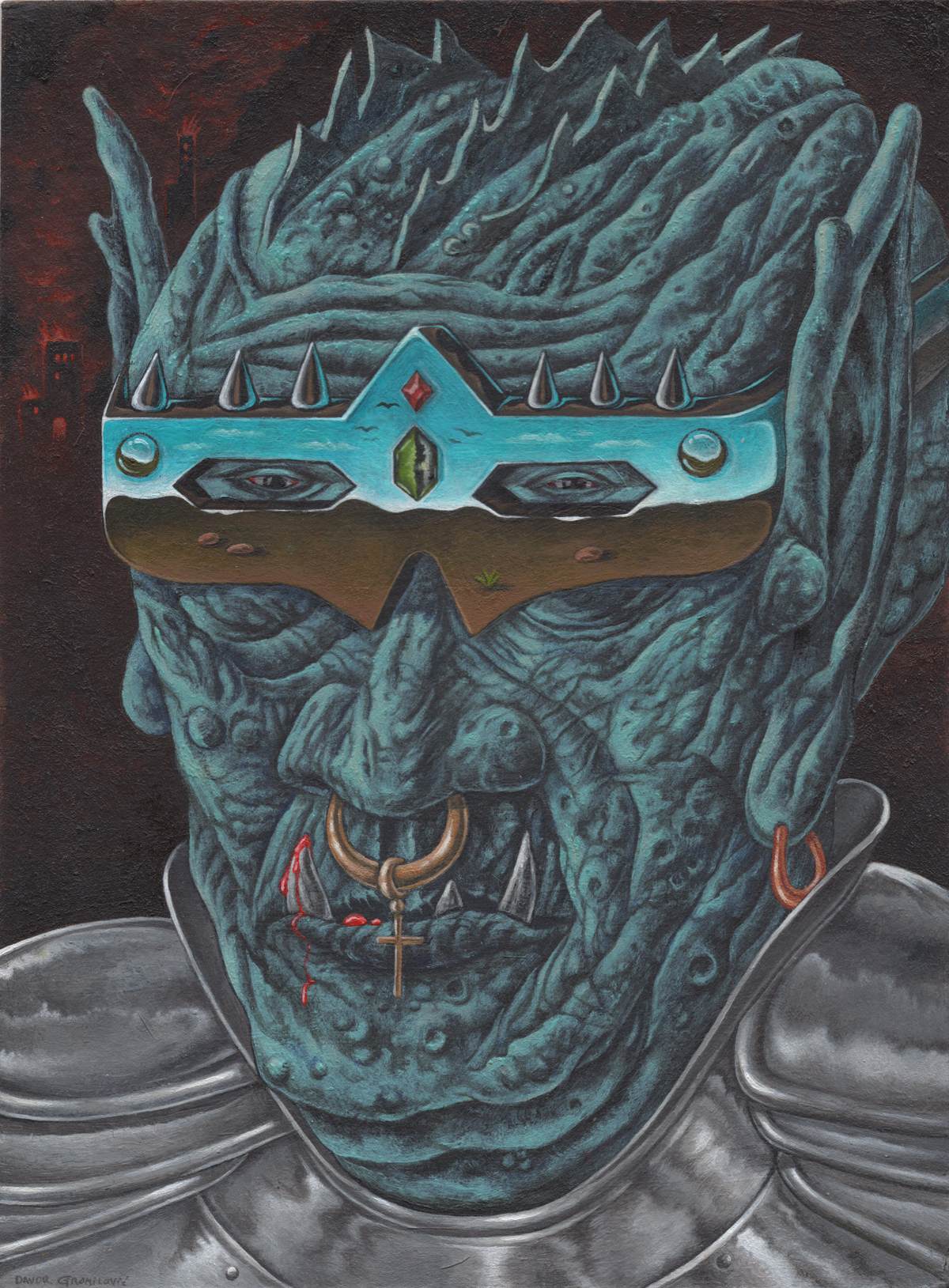 Davor Gromilović continues to craft lush fantasy worlds in his drawings and paintings, with both massive scenes and intimate looks at his monsters. The artist is constantly experimenting in his works, toying with perspective in odes to NES games or blending textures. Gromilović last appeared on our site here.
 Kenta Torii’s vibrant paintings are a striking blend of traditional imagery and contemporary sensibilities. The Japan-born artist, who has been based in Mexico for more than a decade, offers this in both traditional works and murals. WIthin these works are also hints of tattoo and street culture, integrated into his fantastical creatures and scenes.
Lorem ipsum dolor sit amet, consectetur adipiscing elit. Ut elit tellus, luctus nec ullamcorper mattis, pulvinar dapibus leo.