


A Wild Night Out: The Art of Anna Park
Visual artists have long extracted complex psychological themes from festivity. Dutch Golden Age painter Jan Steen reflected on social ideas and humor through merry kitchen tables and sitting rooms. The legendary Utagawa Toyoharu’s bustling ukiyo-e woodblock prints showed aristocracy and erotica. You’ll find the party life explored on museum walls exploring all eras of art (and human) history. And centuries after first traversed, the thread evolves with the visceral works of artists like Anna Park, whose charcoal and graphite scenes present an intimate, wild, and alarming reflection of our unchained selves.
In Park’s drawings, contemporary party-goers mingle and cavort, each a snapshot that can appear at once playful and somewhat sinister. Park is aware of—and intentionally facilitates—that tension between revelry and danger. There can be no misconception of whether her parties are going haywire or down a relatively safe path. That answer lies inside the viewer. “I’m actually hoping for some ambiguity from the scenes I make,” Park says. “It’s like any wild night out; it’s a fine line of how things are going to end up. The moment in between feelings of ecstasy and complete chaos. I guess when you go on either spectrum far enough, the sensations have a similar quality to them. The interpretation is completely up to the viewer in what kind of party it is or will be.”
Park stirs social media conversations each time she posts a new drawing. Commenters vary from those wistfully relating to the affairs, and another simply stating, “Hell looks like that” or “I both hate and love your work. The greed, the avarice, the indecision, the calamity of being human.” Regardless of interpretation, all seem to be enamored by what’s on display. Though her works are best experienced in person, they carry a certain life on platforms like Instagram, where often the best versions of ourselves are broadcast. These are not our best selves. Being easily identified in one of these situations would expose a side of yourself you’d like to keep far from the watercooler. But in Park’s drawings, faces are often obscured, blending into backdrops or melding with a peer’s.
it’s a fine line of how things are going to end up. The moment in between feelings of ecstasy and complete chaos.
I tend to imagine myself in any one of the characters I create in these scenes.
It provides a chance for projection from the viewer and Park herself. “I think we all create a sort of alter ego for ourselves,” Park maintains. “In this case, I tend to imagine myself in any one of the characters I create in these scenes. Having moved around a lot during my most formidable years, it really forces you to mold yourself into a lot of different situations. The way I obscure and abstract certain areas in the work and render others is a way I represent those experiences.”
This fall, Brooklyn-based Park will head into her final year in the MFA program at New York Academy of Art. Surely, her body of work benefits from living in the midst of academia and her current, nightlife-driven setting. She says that through this program, she’s “learned so many valuable tools in understanding more about myself through my work. The dialogues facilitated with the faculty and my peers pushes me to think beyond just the technical and have really changed the way I viewed or think about art.”
Still, the technical aspect of works such as the sexually charged “Mayo,” the buffon-filled “Parent Teacher Conference,” and the folksy “Family Portrait” is noteworthy here. The figures involved oscillate between cartoonish and a more classically influenced realism, both styles gorgeously rendered by Park and wholly integrated into the kineticism of her scenes. She cites the former stylistic sensibility as a recent development, a fascination with decades-old comic strip camp; the effect is jarring and somehow adds to these works’ visceral nature. “Recently I got to a point where I felt as though the way I was rendering forms [and] figures in my drawings started to become a bit formulaic and generalized,” she says. “I was thinking of ways to introduce a different style by gradually distorting and abstracting certain parts of my work. I had always been drawing cartoons since I was a little kid and was wondering how I could bring that element into my current process as well. I wanted the technical rendering that I was learning through figure drawing classes and the goofy caricatures to exist in the same world.” She cites MAD Magazine comics as an influence in the more exaggerated characters that populate her drawings.
Like the parties themselves, Park’s execution in charcoal and graphite is also a game of chaos and control. The movement found in each piece is a result of her speed and agility in this mode. Charcoal has often been a vessel used to convey physicality. In Park’s hands, she serves as the master of several micro-narratives in one centralized setting. Each corner carries its own implications and motivations. The result is as sociologically fascinating and confusing as a drunken night out often feels. She also uses her control of the material to offer political winks in the corners of her work. A “Make America Great Again” cap has a question mark scrawled at the end. The face of one reveler, bottle in hand, only suggests the visage of our forty-fifth president.
charcoal allows me to see my ideas come to life as soon as I conceive them…
“I feel as though the reason why I keep gravitating towards those mediums is because the immediacy of charcoal allows me to see my ideas come to life as soon as I conceive them,” Park says. “I sometimes make preliminary sketches prior to going into a piece, but for the
most part, I like to start drawing right away when the concept is fresh in my mind. The charcoal allows me to produce a wide range of values within the pace I enjoy to work in. And being a rather simple and straightforward medium, it challenges me to push the possible capabilities that it can offer visually.”
In the beginning of work on a scene, the artist keeps it “very loose and gestural in the beginning, to not lose the feeling of movement throughout the piece.” And unlike her seventeenth-century predecessors, the web now provides an endless trove of source material for the artist to then pull details from. She finds herself digging through “cheesy” and “awful” stock images and memes in her journey down internet rabbit holes. It is these touches that allow her work to feel wholly contemporary and universal at the same time. “I find it funny how searching up such benign statements on the internet provides you with an endless amount of unexpected, at times disturbing, content,” she says. “I pick and choose what aspects of different photos that I like and integrate my imagination into them.”
This specific body of work has grown just over the couple years of the artist’s collegiate career. Those studies began with a stint at New York’s Pratt Institute in 2015, with the artist moving onto her current school and this summer, onto Leipzig for a residency. (She then has one more year left at the New York Academy of Art.) During that time, the awards have stacked up: Utah State Sterling Scholar for Visual Arts, a Foundation Merit Award, a Drawing Scholar Award. A recent social media shout-out from KAWS was the latest in peer recognition. And her work has been found in group shows like Women in Spaces: Past / Present at FIX Collaborative and Drawn Together Again at Flag Art Foundation. All of these suggest that Park’s crowded drawings carry weight among any crowds finding their way to her work.
Yet what the artist is exploring in her party scenes is more than just our most extraverted lives. They are also insular explorations, a look at how we all change within the many backdrops of our lives. “In any situation that we are placed in, people tend to shift into different versions of themselves,” she has written. “Whether it be to assimilate to the surroundings around us, or how our environment influences us subconsciously, it’s our own way of adapting. Having moved around for the majority of my childhood, I was making constant adjustments to the new settings I was presented with. What I didn’t realize at the time was the fact that not only were the places I inhabited changing, but my own outlook and perceptions on life were being transformed.”*
This article was first featured in Hi-Fructose issue 52, which is now sold out. Get our latest issue while supporting our independent arts coverage by subscribing to Hi-Fructose here.
 Futaro Mitsuki's hyperdetailed drawings use pointillism and mythology to craft absorbing scenes. The Tokyo-born artist crafts works that infuse a broader art history with traditional Japanese iconography. With works like 2017’s "Monna Lisa,” that infusion is both startling and most present.
 In his current show at Copro Gallery, Allen Williams offers haunting visions in the form of new paintings and drawings. "The Hidden Light," running through Jan. 11 at the space, features both lush scenes and sparse studies in the artist's mysterious style. Williams was last featured on our site here.
 Artist and illustrator Ty Derk's work has roots in fantasy illustration, but his personal projects stray far from the conventions of the genre. Monochromatic and set against clean, white backgrounds, Derk's drawings present viewers with scientific sketches of alien specimens. Marine life fuses with elements of the human anatomy and even architecture. His creatures are armed with barbs, pincers, and armor-like exoskeletons — definitely not something we'd want to approach in the wild.
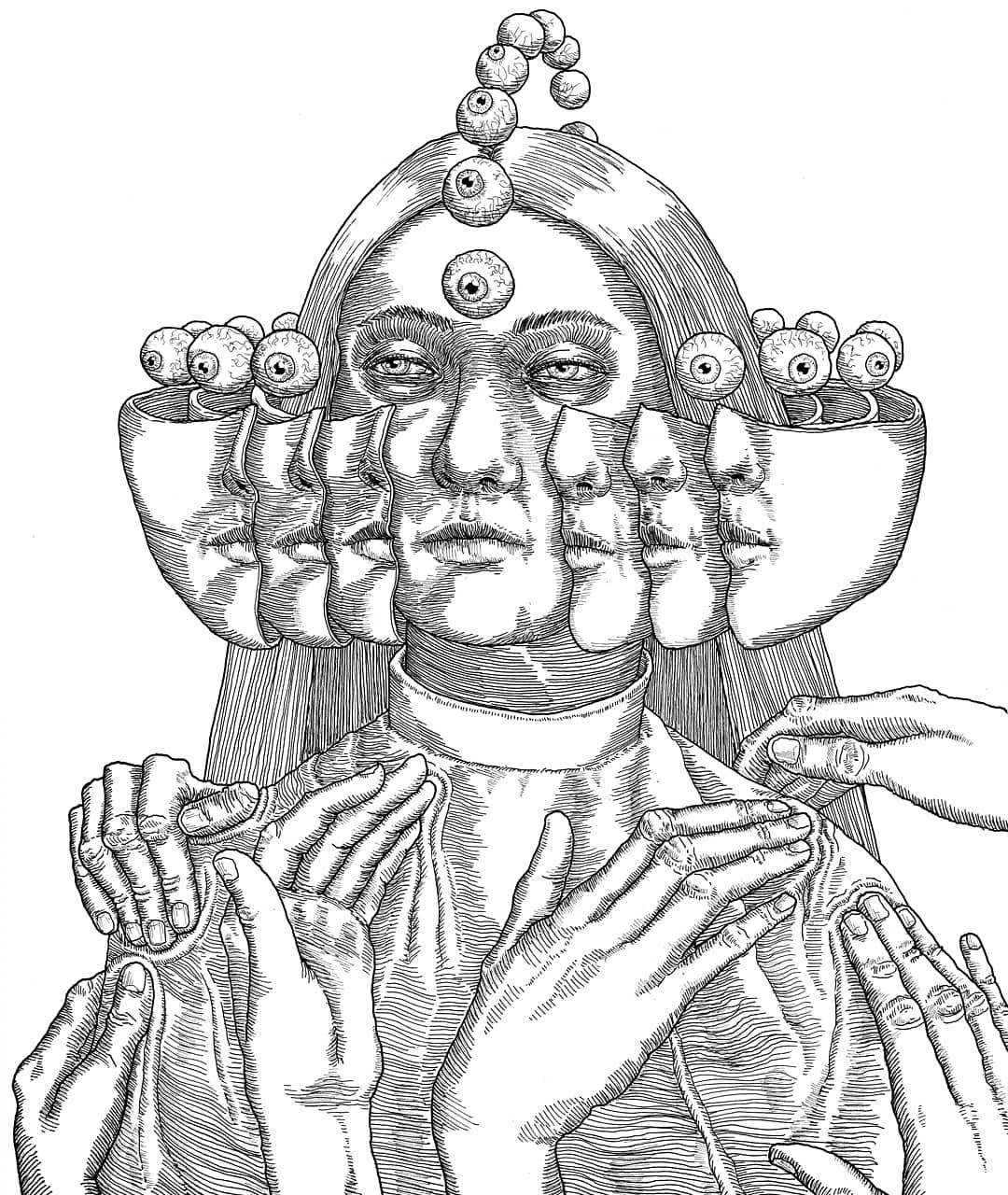 In his riveting, surreal ink drawings, Peter Striffolino builds new creatures from humanity’s building blocks. Though the Los Angeles artist's practice encompasses these drawings, paintings, and animations, we'll be taking a look at his ink work in this post. In his monochromatic work, Striffolino’s talents in texturing and linework is on display.
 Using just a pencil and paper,
 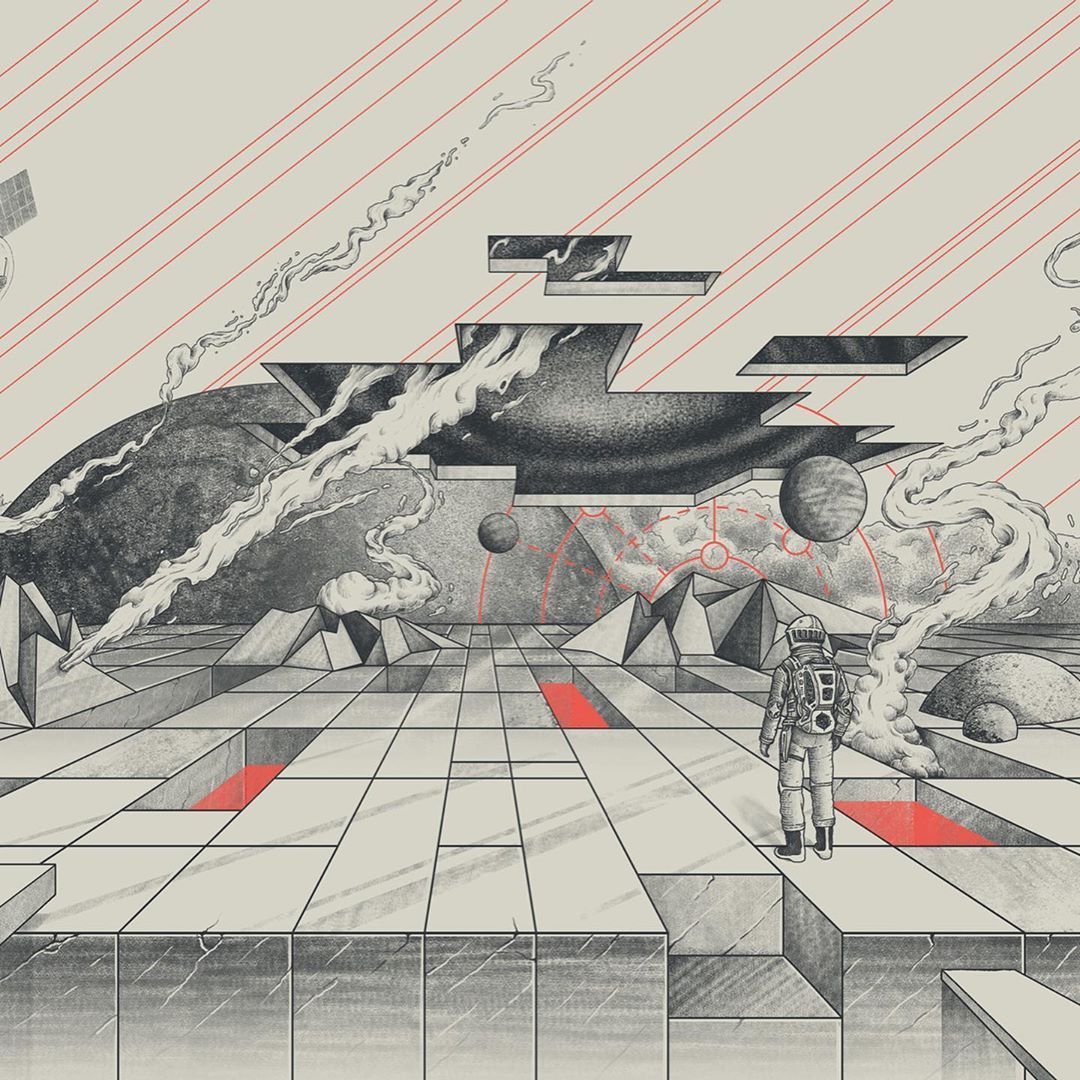 In the work of Lucas Lasnier, also known as PARBO, geometric forms collide with and infiltrate our reality. Whether adorning a wall or a page, Lasnier’s penchants for both the abstract and the realistic are at play. And Lasnier’s background in urban art comes through even in his more commercial ventures.


