Menu
The New Contemporary Art Magazine

Kaitlyn Schwalje’s ‘Unfit for Consumption’ Looks at Consequences, Causes of Disaster

At first glance, the Kaitlyn Schwalje sculpture “Unfit for Consumption” appears to tell a parable of some sort. The top of the piece scene seems serene, with grazing boars and a strange liquid form taking shape. Yet, a more ominous narrative forms when one looks below. The truth is that Schwalje’s sculpture has even stranger, yet real-world origins.

At first glance, the Kaitlyn Schwalje sculpture “Unfit for Consumption” appears to tell a parable of some sort. The top of the piece scene seems serene, with grazing boars and a strange liquid form taking shape. Yet, a more ominous narrative forms when one looks below. The truth is that Schwalje’s sculpture has even stranger, yet real-world origins.


In 2011, the 9.0 magnitude earthquake that struck outside of Tokyo, and its accompanying tsunami, brought further disaster to the Fukushima Daichi nuclear power plant. Evacuations followed, yet the boar population, immune to harm from the radiation, flourished. The boar began to threaten farmland, and now, the radioactive creatures are killed and buried in a few mass graves 35 miles from the power plant.

The artist is the daughter of a safety engineer, an expert in disasters. “When a factory worker’s hand is ground into a chicken processing machine or when someone slips down the stairs, he figures out why it happened and who was at fault,” she says. “He is a professional expert witness: he testifies about everything from the lighting codes of stairwells to the material analysis of stress fractures in steel.”

Thus, Schwalje had an “education in disaster” growing up. “I became fascinated by the mechanisms that govern how everything works, from physical architectures to people and their behaviors,” she says. We also see hints of this in “A Stage for the Worst of Times,” a miniature theater set created by the artist. From the Challenger shuttle to Germanwings Flight 9525, the artist’s fascination is on display.


(Photos by Alexander Lewis.)

Meta
Share
Facebook
Reddit
Pinterest
Email
Related Articles
Italian artist Mauro Perucchetti is instantly recognizable for his eye catching colored resin figures. Among these, one series in particular stands out for its stark contemporary twist on well known sculptures. Perucchetti describes his "Modern Heroes" series as classic-pop, fiberglass re-imaginaings of works by master artists like Michaelangelo and Auguste Rodin. In his statement, Peruchetti writes that he "unites Pop aesthetics with social comment to address some of the most pressing and difficult issues in today’s society in a way that is subtle and accessible, without being trite, shocking or obscure." Since May of this year, "Modern Heroes" has been featured at the Pacific Design Center in Los Angeles.
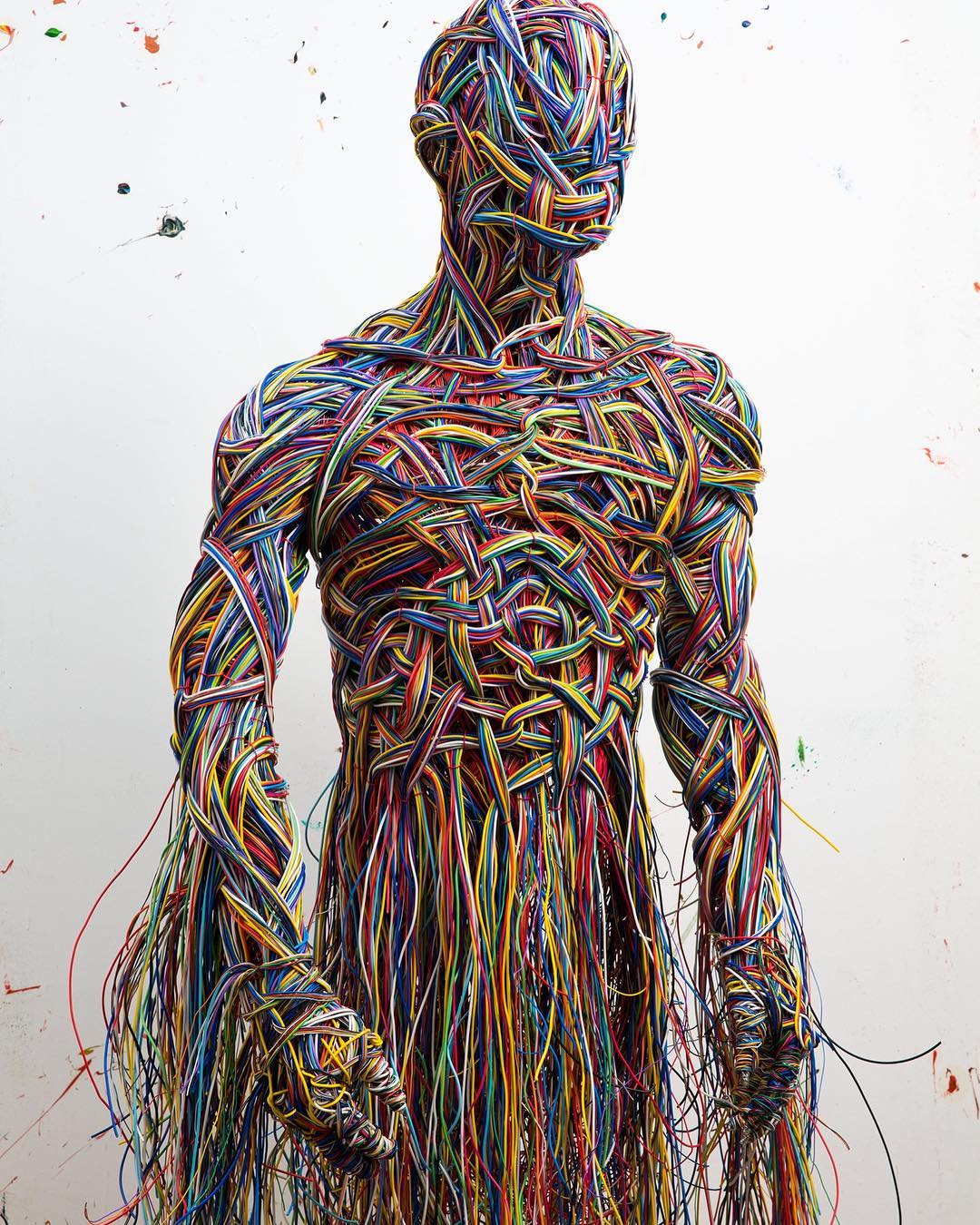
Salman Khoshroo builds figures out of electric wire, with the resulting character being made for both close inspection and movement. His reflections show the ties between the human machine and the manmade machine. And his kinetic sculptures, in particular, tell of the inherent ability for motion in both of these.
Along with HOT TEA and AJ Fosik, Okuda San Miguel is part of one of three artists crafting installation projects at SCOPE Miami Beach's atrium (Dec. 4-9), marking Hi-Fructose's 14th year in publishing. We recently caught up with Okuda on his major projects from this year and what's ahead. (He was also the cover artist for Hi-Fructose Vol. 43, available here.)
Vipoo Srivilasa works predominantly in ceramics. He uses porcelain clay to hand build his work, then he paints over it with cobalt oxide to obtain the blue color. The last step of this process consists of firing the work at 1200°C. According to the artist, his work is saturated with symbols taken from different religions, although it’s not meant to evoke religion itself, but rather to reinvent certain religious images. "For the series Roop-Rote-Ruang (Taste-Touch-Tell), I used the Buddhist philosophy of Ayatana as a reference for my work. The Roop-Rote-Ruang (Taste-Touch-Tell) Project is a series of dinner parties that I hosted to embrace the Buddhist concept of "Ayatana" and the six “channels of awareness” (my guests’ sight, taste, smell, hearing, touch and mindfulness)”, he says.

Subscribe to the Hi-Fructose Mailing List