Menu
The New Contemporary Art Magazine

Dmitry Kawarga’s ‘Anthropocentrism Toxicosis’ Installation Series

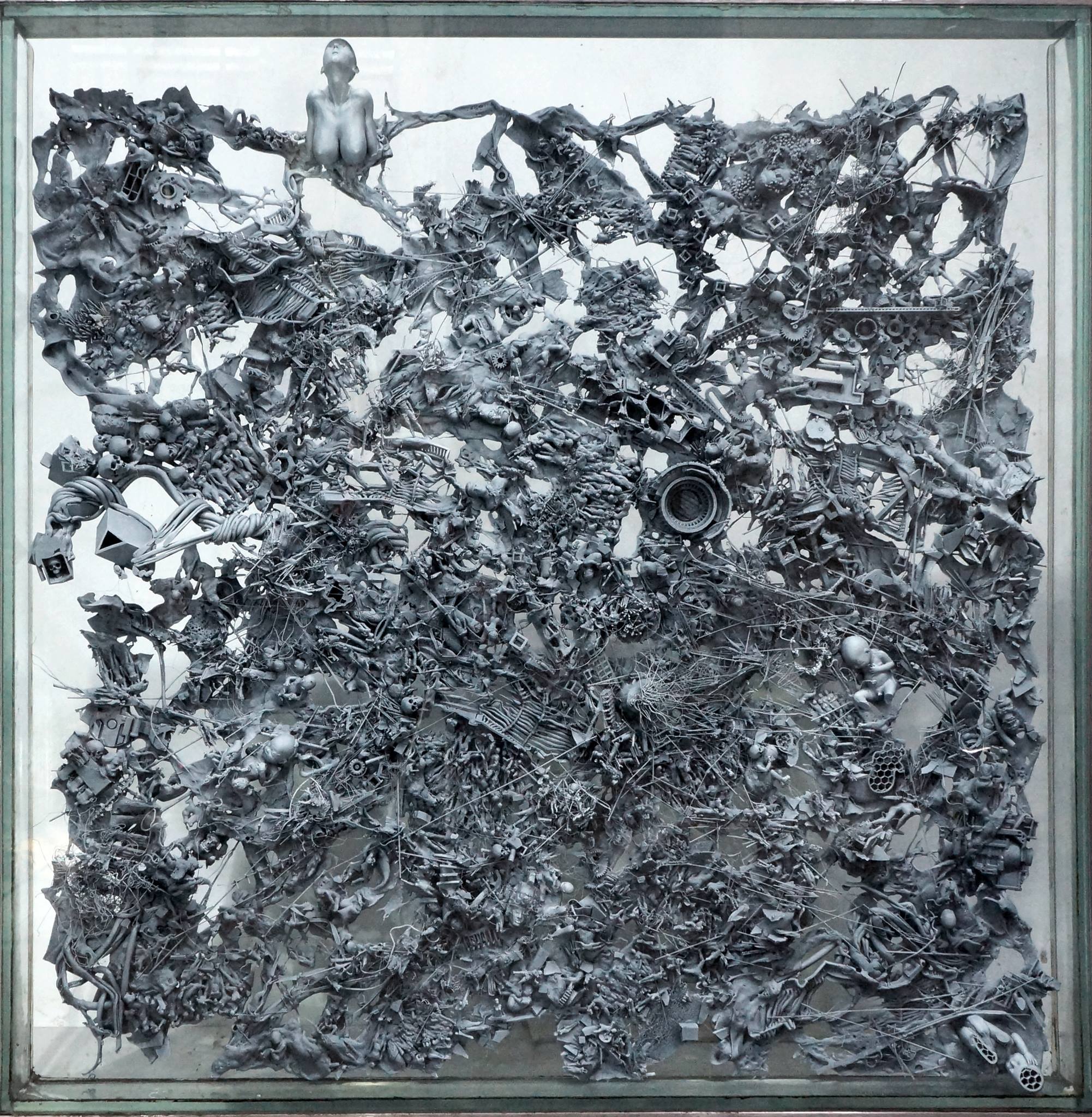
In his first exhibition in Hungary, Dmitry Kawarga's "post-human" sculptures and installations reflect on humanity's vulnerability. His "Anthropocentrism Toxicosis” series, in particular, is on display at the Ferenczy Museum, with works built with polymers and occasionally, usage of 3D-printing processes. The exhibition runs through Sept. 15.

In his first exhibition in Hungary, Dmitry Kawarga’s “post-human” sculptures and installations reflect on humanity’s vulnerability. His “Anthropocentrism Toxicosis” series, in particular, is on display at the Ferenczy Museum, with works built with polymers and occasionally, usage of 3D-printing processes. The exhibition runs through Sept. 15.

“In Kawarga’s view, humanity will soon disown its biological self, and separate from its physical body,” the venue says. “However, in addition to looking at how things human and non-human are related, and using the opposition of organic nature and geometric technology to reveal how the population changes, this special artistic project shows these changes, above all, in the crisis of anthropocentrism, which posits man as the centre and ultimate cause of the world. Objects are presented in Plexiglas cylinders, compacted in prisms, and sometimes on their own: discarded things that have survived their own worlds, flowing over and covering a postapocalyptic wasteland.”

Read more on the venue’s site here, and find more from the artist here.

Meta
Share
Facebook
Reddit
Pinterest
Email
Related Articles
At Coachella, the action contained within an 80-foot-tall wooden rocket towering over the festival became a star of this year’s visual artist line-up. Duo Dedo Vabo created "H.i.P.O.," in which performers dressed as hippos clanged and banged away at projects in a 12-hour, uninterrupted performance. This installation took a year to conceive and complete, with "202 designers, costumers, set decorators, stage managers, riggers, and performers" involved. (Press images captured by Marshall Vanderhoof.)
Creating minimalistic sculptures out of wooden sticks and hot glue, Polish artist Janusz Grünspek’s series “Drawings in Space” reduces everyday objects to their most simplified states: their outlines. He makes use of negative space to suggest a transparency where opacity is expected- each of his creations is life-sized and Grünspek’s precision tempts the viewer to use them as if they were the real things.
Known for his provocative installations that bend both reality and perception, Danish-Icelandic artist Olafur Eliasson (previously featured on Hi-Fructose) aims to emphasize the relativity of reality. In his latest of many ambitious projects, he situates his works in the stunning baroque space of the Viennese Winter Palace of Prince Eugene of Savoy in an aptly titled exhibition, "Baroque Baroque". While the relationship between his contemporary work and the extravagant exhibition space might not be clear at first, it comes into focus as both the art and its setting reflect a “prolific process of constant reformulation.” The double title emphasizes how the exhibition is a reformulation of a reformulation- a space of altered expectations and aesthetics.
Chris Jones's large-scale sculptural work looks fragile even though his subject matter often focuses on objects we presume to be tough, stable — even nearly unbreakable. In his current show at Mark Straus Gallery in New York City, a sports car melts and unravels before our eyes. A motorcycle tempts us to scratch and peel away its layers. Houses disintegrate into heaps of deteriorating objects. Jones works with abandoned and disused materials — old magazines, books, encyclopedias, paper ephemera and even trash — to create papier mache pieces that destabilize our view of the world around us. We create our environments through the accumulation of objects and materials. Jones's latest body of work pulls us back, reminding us how ephemeral and artificial these things are. It's a bleak reminder that material objects and the world we've built will not stand the test of time.

Subscribe to the Hi-Fructose Mailing List