Menu
The New Contemporary Art Magazine

The Vibrant 2D and 3D Work of Mark Whalen

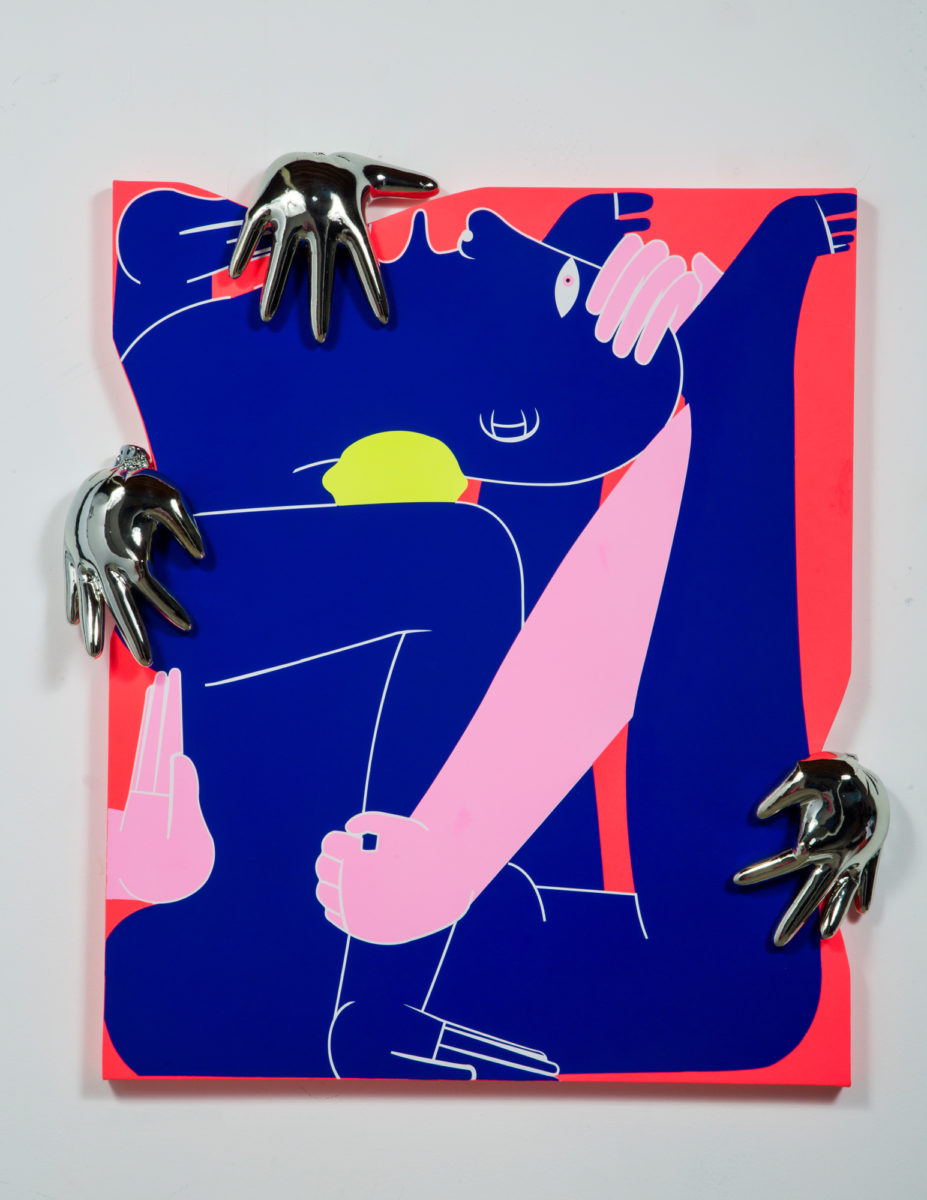
Blending two- and three-dimensional forms, Mark Whalen creates cerebral and absurd arrangements of the human body. Whether stacking vibrant heads or using sculpted hands to sculpt the very shapes of canvases, there’s a metatextual component in tackling the act of creating art itself.

Blending two- and three-dimensional forms, Mark Whalen creates cerebral and absurd arrangements of the human body. Whether stacking vibrant heads or using sculpted hands to sculpt the very shapes of canvases, there’s a metatextual component in tackling the act of creating art itself.

“The generalized, gender-fluid figures who appears in the pictorial scenes and whose body parts are featured in the sculptures is not Whalen himself — or it’s not only him,” Over the Influence has said of his work. “The figure is an avatar for the broad spectrum of human experience. The seductive richness of the saturated palette and alluring surface treatments evokes a range of emotional responses to that life; and the ordinary found objects and minerals that surround, support, and oppress the persons in the compositions represent the profound absurdity of basically everything.”

Find more of Whalen’s work on his site.

Meta
Share
Facebook
Reddit
Pinterest
Email
Related Articles
Lene Kilde, a sculptor based in Norway, creates works in which disparate body parts create fanciful scenes. At first glance, these sculptures may appear ominous or bleak, but further time spent with the work offers hints at wistful and youthful action. Or as Kilde says in a statement,“her intention is to invite the audience to use their own imagination so that they can complete the sculptures and fill in the lines and volume by themselves.The sculptures consist (of) concrete, metal mesh and air.”
Design collective Numen/For Use was incepted in 1998 as a way for its members — industrial designers Sven Jonke, Christoph Katzler and Nikola Radeljković — to push the boundaries of architecture, design and conceptual art. They've collaborated on everything from furniture design to elaborate installations that invite the viewers to break the norms of how they ordinarily interact with space. Rarely do we see adults take off their shoes to bounce and play, but Numen invites their audiences to do just that. Their latest piece, String in Vienna is an inflatable, bounce house-like structure with an elaborate grid of cords that allow viewers (more aptly, participants) to defy gravity. Their other recent works include a levitating cave made out of clear tape in Tokyo and another inflatable structure with hammock-like netting hung strategically for optimal bouncing in Yokohama, Japan.
Massachusetts based sculptor Tom Friedman’s work is instantly recognizable for its surprising use of materials like styrofoam, foil, paper, clay, wire, plastic, hair, and fuzz. "I don’t think about the construction of meaning. I think about the creating a catalyst for thinking. Meaning is too concrete. I want the viewer to think in different ways. I want to propose an ongoing process of investigation with no conclusions," says Friedman. The artist's great emphasis on materials makes him an analog artist in a digital world, and people looking at his work often remark on it's "zen-like" quality.
Meredith James is like a latter day Alice in Wonderland documenting what she sees in her journey down and through a contemporary rabbit hole. Her videos, installations, and sculptures play with scale and trompe l’oeil to create optical illusions that are as disruptive as they are funny. In "Day Shift", a short video, she plays a security guard who, having just left work, crawls into the backseat of her SUV and reemerges as a miniature figure in the building's security monitor. In Ames Landscape, an installation, two figures stand in a glade. A large mountain reaches skyward in the distance. The space is configured so that, though the space is logically consistent, one figure stands much taller than the other. In Hallway, another installation, a door opens onto stairs that lead down to the basement. The stairs, of course, go nowhere because the space is flat. The fact that the illusion is a dead ringer for the space's actual stairs that lead to a real basement is not even remotely coincidental.

Subscribe to the Hi-Fructose Mailing List