


Eric Green’s meticulously detailed drawings replicate life beautifully- but there is something off about them. “When you really begin to understand life, everything changes completely all the time. Nothing is ever the same again,” he says. Working primarily in colored pencil, Green draws images that are meant to change our perceptions by illustrating the subtleties between moments as light changes and objects are mysteriously moved by unseen occupants.
Titled “Time Diptychs and Mirrored Rooms”, his latest series depicts interiors within his own home in Belfast, Maine, which he’s spent the last seventeen years adjusting and perfecting. “This latest series is an attempt to capture time, or the poetic phrase, “the sad beauty of time passing,” something I believe we all experience in life, an emotion that gives existence much of its intensity and meaning. It’s not an easy sensation to describe, so I’m hoping this work will allow the viewer to experience it in a clarified visual form.”

“What I find interesting is that the art itself can only exist in the viewer’s mind. It is the amalgamation or comparison of the two images that creates the specific emotion, not each individual panel. Gauging and balancing this convergence is everything,” Green says. As if we were looking through a broken mirror, the artist flips images upside down and reveals secret movements between panels, relying on diptychs to tell a story; a lamp switching on, balls rolling across a pool table, or the light dimming as the day turns from dawn to dusk.
Green explains: “With the bombardment of media today, we forget the simple pleasures of just seeing. There’s been a tendency in the last 50 years of art to ‘get it’ in the first few seconds and then just walk away. I hope that having the two panels to compare, it slows people down and they want to spend some time to see. Even if it’s just to figure out what’s different between the two panels, but it’s the beginning of learning how to really look and see something.”


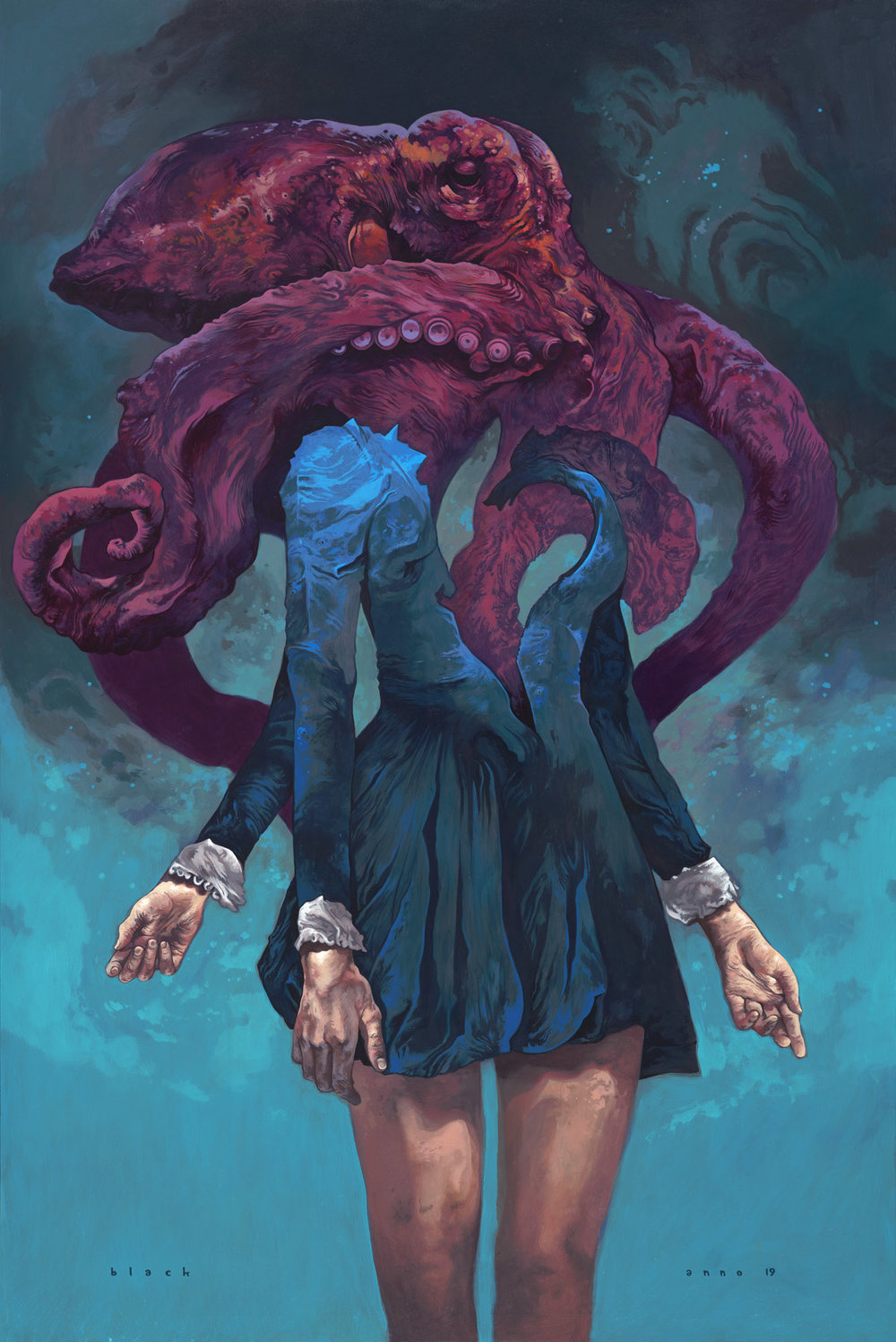 Steven Russell Black’s horror-filled paintings and drawings have a cinematic quality. Black refers to himself as a "painter with an obsessive compulsion to champion the odd, fringe, or otherwise unappreciated." In his drawings, these scenes and characters carry an even more ghostly quality.

 Colombian illustrator Carolina Rodriguez Fuenmayor crafts riveting, cerebral scenes. Though her work often features solitary figures, much of her themes seem to stem from a universal sensibility. And in much of her work, unexpected hues and amorphous, enveloping forms underscore the works’ psychological nature.