


Future Pastime: The Paintings of Late Futurist Syd Mead Arrives At The Transamerica Pyramid Center in San Francisco
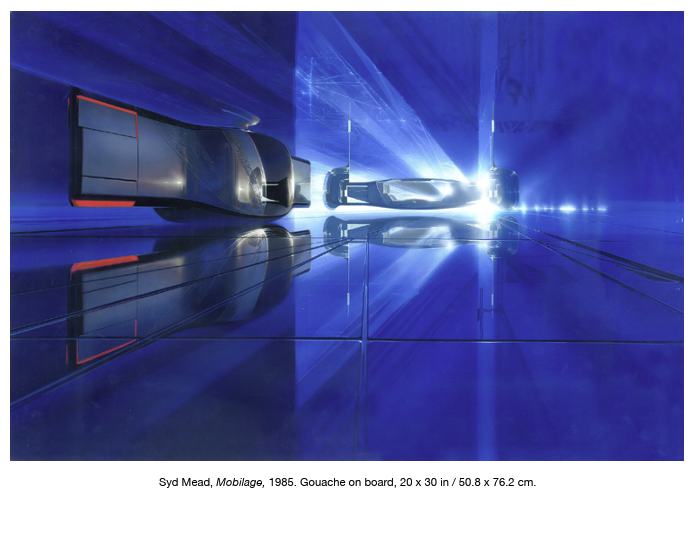
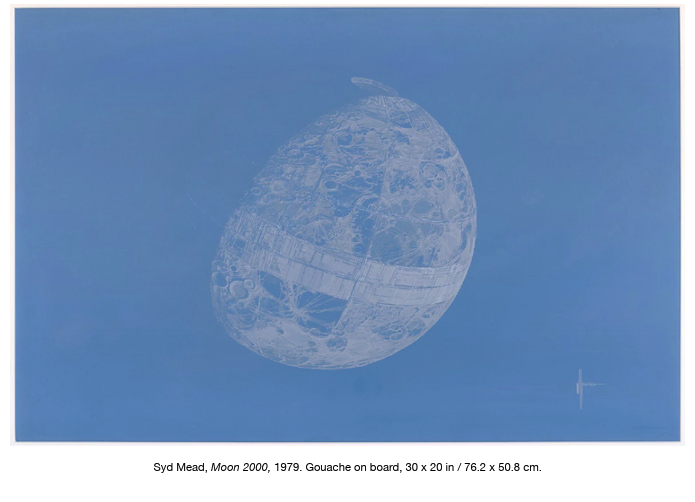
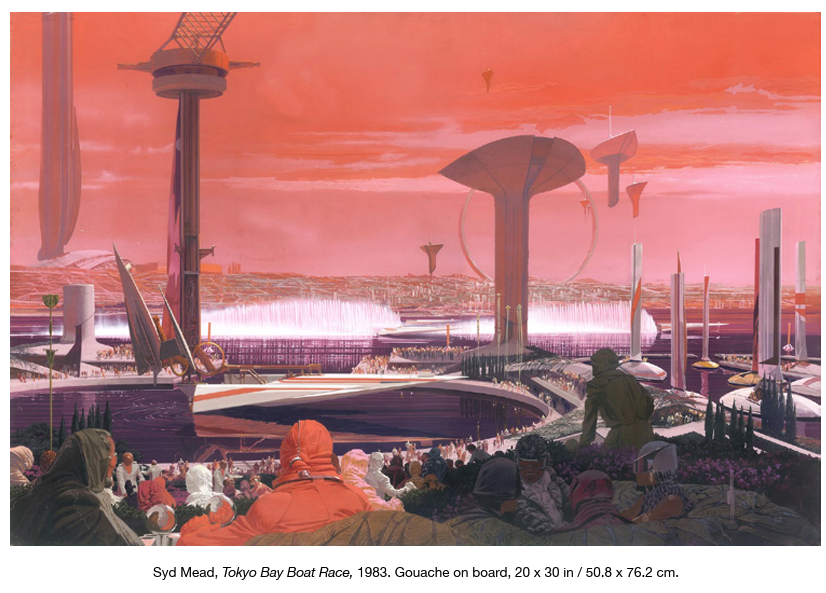
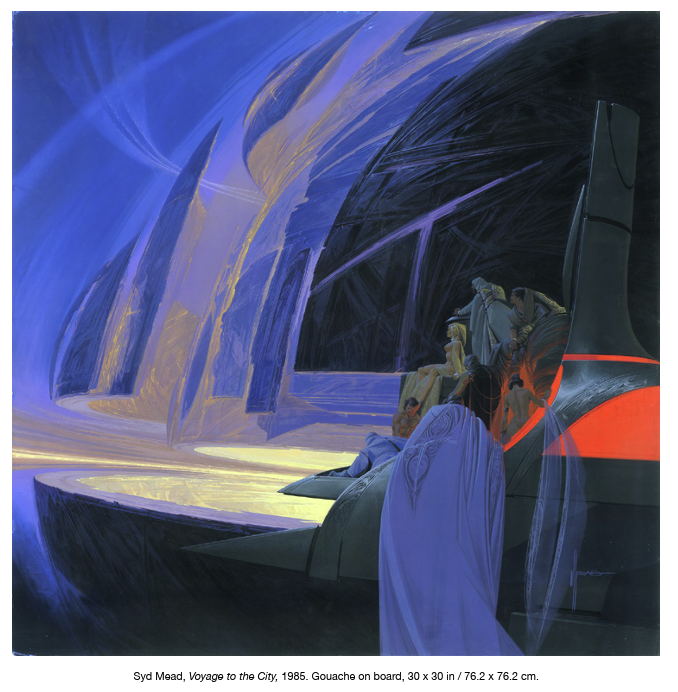
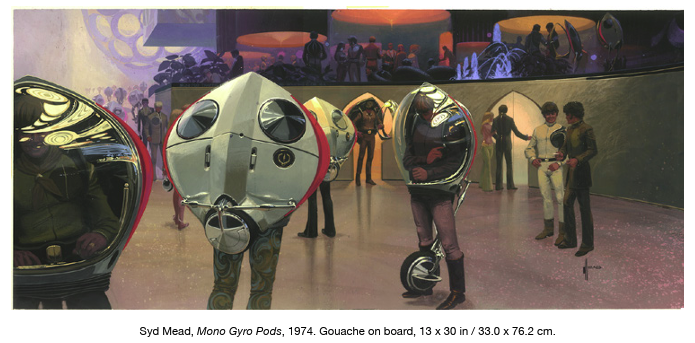
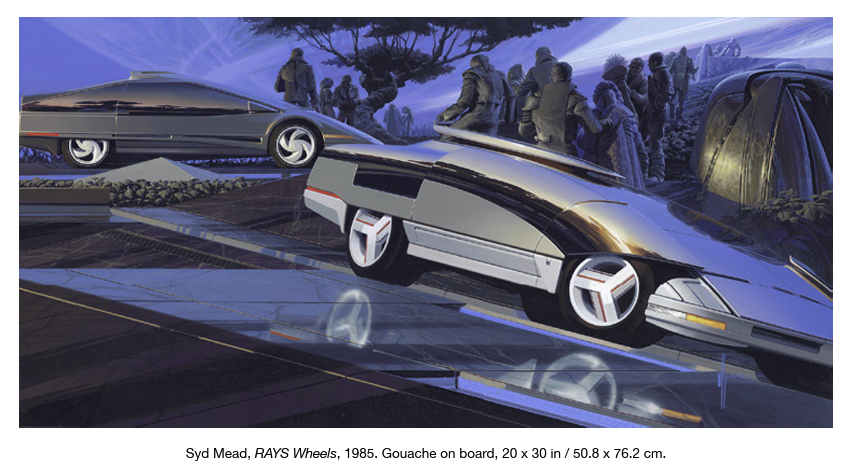
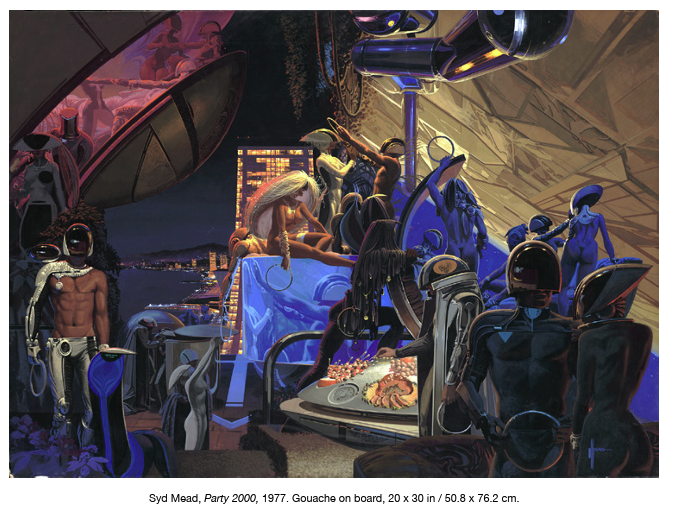
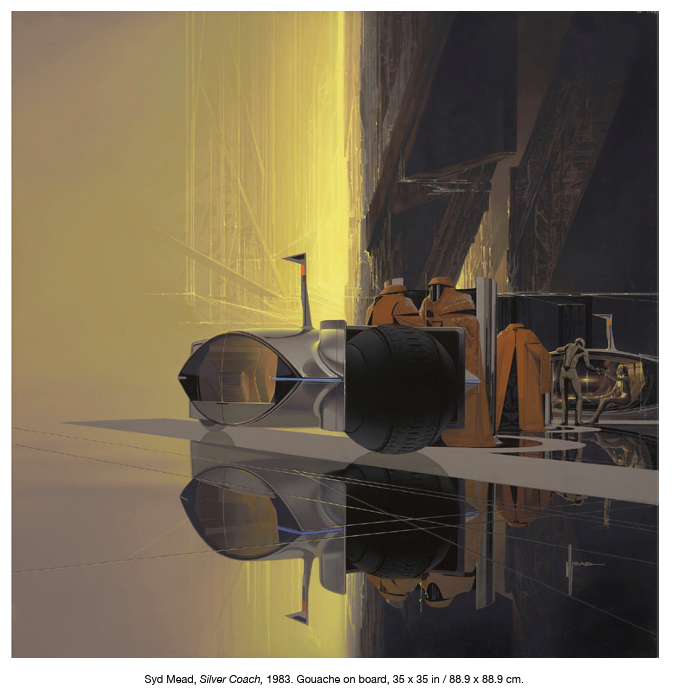
To celebrate the retrospective exhibition Future Pastime featuring the work of futurist Syd Mead opening at the Transamerica Pyramid Annex Gallery in San Francisco this evening, we are showing previews of paintings from the show as well as the full article which Silke Tudor wrote on the late legendary industrial designer in Hi-Fructose Issue 33.
The new exhibition curated by Elon Solo and William Cormanis presented in collaboration with MAD Architects the architects of the just launched Lucas Museum of Narrative Art in Los Angeles,
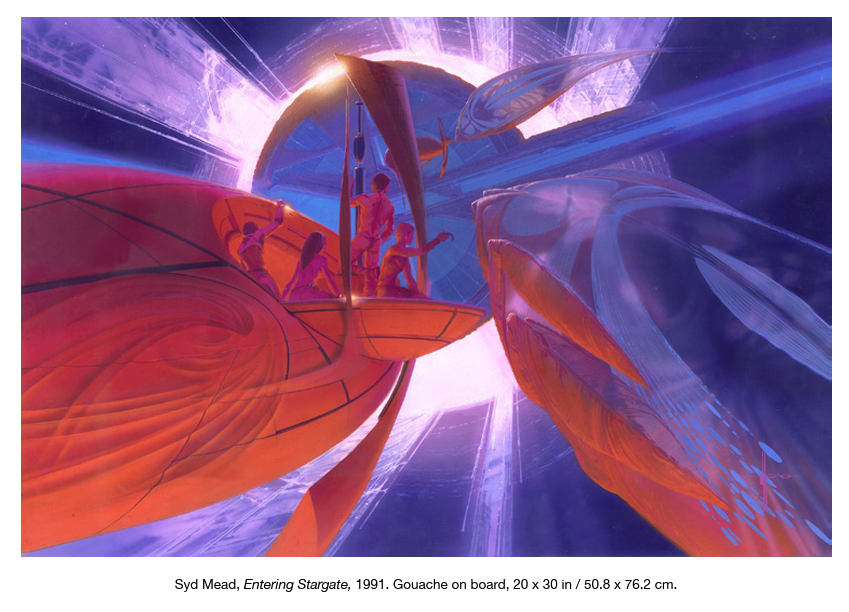
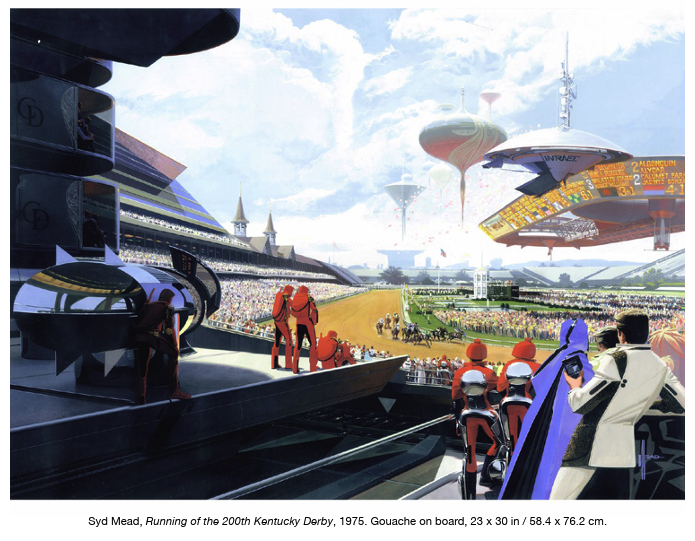
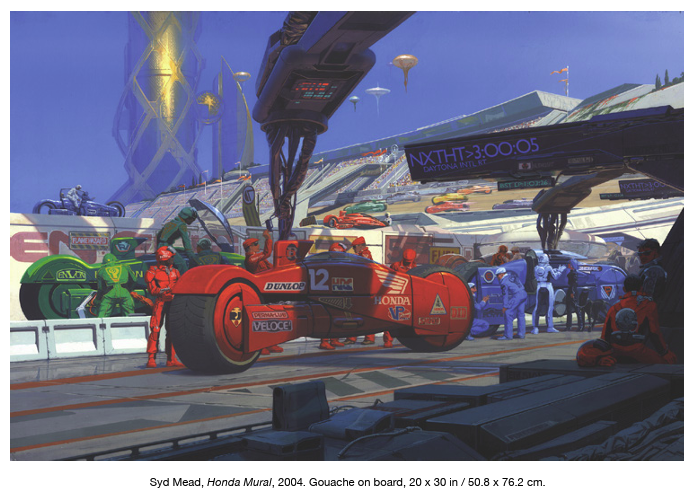
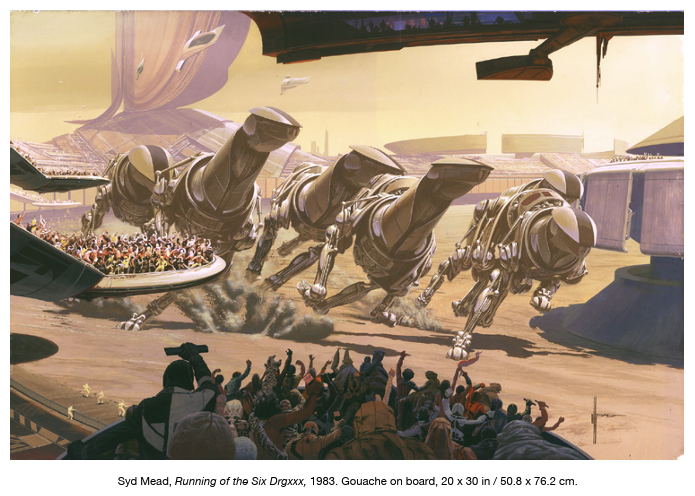
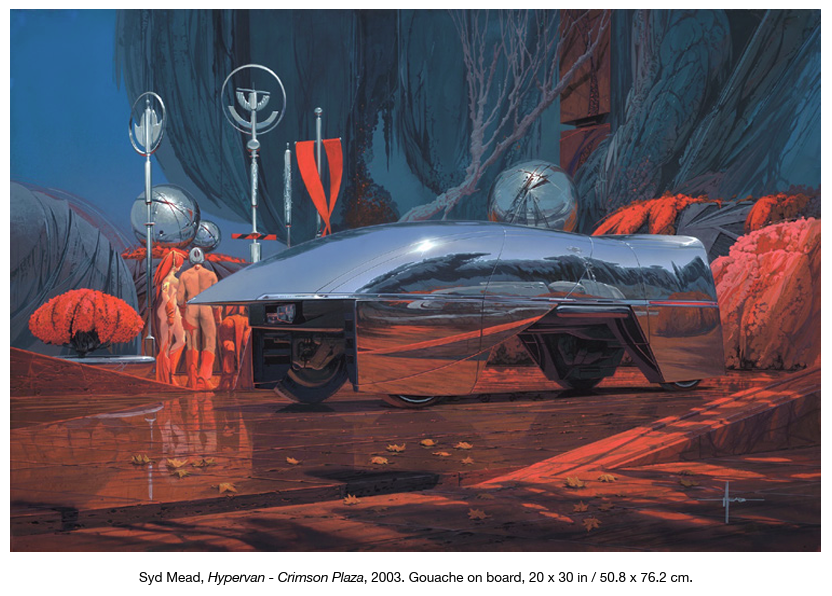
Say the curators: “The Mead’s futures are not distant utopias, but commonplace visions of life yet to come: a casual drive through a cerulean blue intergalactic space, a canine racing event where the dogs are mechanical and soar above skyscrapers, and a dinner party where guests sport steel couture. Where San Francisco’s present-day conversation about technology so often circles between anxiety and detachment, Mead’s future is neither dystopian nor abstract; it is lived-in, teeming with humanity. Just as early twentieth-century painters turned away from portraits of the elite to portray the everyday lives and leisure of ordinary people, Mead extended that same instinct forward in time. His figures are not conquerors of the future but its regular inhabitants, spending their days in each other’s company. In Mead’s meticulous gouache paintings, the future becomes something tactile and buildable. Every structure and vehicle is rendered with enough engineering logic that they could be blueprints. If Syd Mead has a single, defining subject, it is this: futurism and technology imagined always as a means of human liberation. Thirty years after his last visit, and at the exact moment the tools he once merely forecasted have finally arrived, Future Pastime asks San Francisco to reconsider the future it is building, and for whom it will arrive”.
“If we start rehearsing a dismal world, that’s the way we’ll end up,” says Mead. “I hope all these dystopian shoot-em-ups are cathartic—I truly hope that’s all they are. In the meantime, I’m doing my small part to visualize a glossy, egalitarian—that means everyone does their part or it doesn’t work—technically advanced society that produces a workable future, and a nicer place to live. That’s what I want.”- Syd Mead (as told to Silke Tudor, HF Vol.33)
Please enjoy our in-depth article on the futurist icon below, with no pay-walls.
Syd Mead spends a lot of time thinking about the proscenium. In theater, the proscenium is the physical archway that segregates stage and audience, but it can also be viewed as the delineating edge of a television or movie screen, or the frame around a painting. It is the gateway between our everyday reality and the world of fantasy. For a very long time, this line has been physical, but things are changing. Recently, Syd Mead and Roger Servick, Mead’s partner of thirty years, were invited to flirt with the edge of the proscenium.
“It was a demonstration of an advanced movie projection technology,” says Mead. “Basically, it was a dome with full rotational 3-D camera projection. The image is all around you. Essentially, you’re there. If you drugged somebody, and they woke up in that environment, they would not know where they were.”
Mead, who recently celebrated his 80th birthday, seems both keen and cautious about recent technological advances.
“Take video games. Today, people play games in virtual worlds and they are essentially unlinking from day to day life. But that’s with primitive avatars on the monitor or television screen with a frame around it.
“There are implants now that can affect the brain’s ability to process—they’re being explored for rehabilitation from Parkinson’s disease, but I can see a dangerous social implication. Because, if this technology, which electively stimulates your internal mindscape, continues to advance it will easily get to the point where people can’t distinguish between external and internal reality, where it becomes real in an odd sense, or like a dream. Because, once you destroy the frame, you’ve lost the proscenium. That, I think, is sort of scary.”
Trepidation aside, Syd Mead has a spent a lifetime tricking our eye into believing in a whole world just beyond the frame, no matter how fantastic, futuristic, or off world that scenario might be. It’s something, he points out, all good directors and cinematographers do, and it is a skill he takes great care to teach the young artists he mentors.
“There is a set of visual rules that help an artist achieve this,” says Mead. “But it’s a delicate skill. You really have to put yourself in the picture, imagine that you’re there so things don’t go wrong.”
This has never been a problem for Mead.
“In my head, I have always been in the story,” he says. “Since I was a little [boy].”
…if this technology, which electively stimulates your internal mindscape, continues to advance it will easily get to the point where people can’t distinguish between external and internal reality, where it becomes real in an odd sense, or like a dream. Because, once you destroy the frame, you’ve lost the proscenium. That, I think, is sort of scary.”
Syd Mead was born in St. Paul, Minnesota, the son of a fundamentalist Baptist minister with a fine arts degree. It seems anomalous to Mead even now. His father kept every single thing his son drew from the age of three, and read him stories about Buck Rogers and Flash Gordon, but he never let him go to a movie theater.
“You see, the devil owned all the theaters,” chuckles Mead whose work on movies like Blade Runner, Aliens, and TRON has influenced generations. “And our family would not support the whores of Hollywood!”
By the time Mead was in high school, he had, as he puts it, “deprogrammed” himself. His first job was for a small film company in Colorado Springs, doing background illustration and character origination for trailers that ran between feature films.
“I started to meet secular people who smoked, and drank, and played cards. Some had gone to Europe! My world suddenly opened up, and all the wrong people poured in.”
In the face of potentially being drafted, toward the end of the Korean War, Mead joined up, a calculated way of exerting some control over where he would go and when. But, even in the Army, his creativity paid off.
“I essentially painted my way through basic training,” reflects Mead, “decorating the mess hall and supply room, and painting naked girls on the backs of my commanders’ field jackets.”
By the time Mead reached Okinawa, he had been trained as a field draftsman and rose swiftly to the rank of training sergeant.
“I was this skinny, nerdy kid with thick black framed glasses,” says Mead. “I only did well because I could draw.”
Mead’s gift was broad. He could capture anything on paper—people, landscape, animals, machines—but his passion had always been transportation. While still in Okinawa, he sent drawings to the chief designer at Ford. He also spent a full month’s worth of accumulated leave soaking up the visual landscape of Hong Kong—it was the first of many travels to broaden his internal foresight.
When Mead’s tour ended, he attended the Art Center College of Design in Pasadena, California. It’s not surprising now that Mead is frequently asked back to his alma mater; but, even as a student, he was a leading light, graduating with distinction and getting snatched up by Ford Motor Company’s Advanced Styling Studio before his feet hit the pavement.
Working in design meant Mead was paid to look fast forward, but the images he created for Ford were not a stretch from those he had been drawing in art school. He was a natural at envisioning future fact and far-out fiction, down to the last scrupulous detail. His vehicles were sexy and sleek, hovering above driveways, or parked on extraterrestrial versions of the Bonneville Salt Flats. The details—wrap-around windows that open like wings, tail-lights that look like torpedoes, trunks that offer a lot more than a spare tire—were eye-candy but they were grounded in possibility. And following Mead’s own guiding principle, his designs often included people—shiny, well-scrubbed youthful people eager for fun, and in full command of everything the future might bring—unlike the work of his contemporaries, which was still rendered in black and white with shades of gray.
In 1964, Mead designed Ford’s famed “Future” exhibit for the World’s Fair but, by then, he was already long gone from the company. He had been wooed by a small Chicago firm with some very big accounts, including Celanese Corporation, Atlas Cement, Allis-Chalmers, most significantly, United States Steel.
“Over one lunch my salary increased five fold,” Mead chuckles. “But it wasn’t the money, it was the complete creative freedom.”
When asked to design a logo for a new synthetic polymer from Celanese, Mead did not just sit down in front of a drafting table in a sterile office, he went to New Jersey and met with chemical engineers. He wanted to know how it worked, and why it worked at high temperature. He approached the subject as a chemist, then as an engineer, and finally as a sociologist, and a consumer. He followed the lines of innate interest and let them flow onto the page. When Mead finally submitted the logo to Celanese, the suits in the room just blinked.
“It was a stylized version of the molecular structure of their own product, but they had no idea what they were looking at,” says Mead. “That’s why they hired me.”
Eventually, Mead did collateral for all the big names on his new company’s roster, including a series of books for U.S. Steel, which he began in 1961. They were game changers. Mead’s “portfolio of probabilities,” as one was aptly subtitled, offered over one-hundred pages of mind-blowing, time-bending transportation, habitation, furniture, fashion, and tech. And the illustrations, many of which still influence our present day vision of a bright utopian future, became seminal.
“Yes, you could say, they went horizontal through the design community,” agrees Mead somewhat offhand.
Today, the books can fetch over a $1,000 dollars apiece on the fine books market, and are sought by art lovers, as well as car enthusiasts and genre geeks. But, back then, they secured Mead’s reputation. In 1970, when he struck out on his own, his first client was a Dutch multinational electronics company called Philips.
The man who said, “The best way to predict the future is to create it” probably had Mead in mind. Over time, Syd Mead took every single Philips product in their catalog and designed it into the future, giving us some of our first glimpses of PDAs, flat screen TVs, Segways, and perhaps, if you look closely, the internet. And as he painted, he told himself stories.
By 1973, knowledge of Mead’s artistry had reached well beyond the industry. He was invited to exhibit at documenta 6, the prestigious modern art event, which is held for one-hundred days every five years in Kassel, Germany. A few years later, he published the first of his own art books, titled Sentinel. Suddenly, the film industry got very interested.
“It made sense,” says Mead. “I always thought of products as props for a movie that will never be made.”
Mead’s impact on pop culture was about to go direct.
Syd Mead’s house actually looks how you might expect, minus the robot tending bar. It is a white post-and-beam flooded with natural light and accented by chrome. There is an impressive display of Hotwheels across from the fireplace, and a pristine ‘72 Imperial in the driveway. (“It’s six feet across inside and weighs two-and-a-half tons,” says Mead of his baby. “It’s ridiculous.”) But, given all of Mead’s movie experience, there is a surprising lack of mementos exhibited. And no original artwork.
“We can’t display them, they deteriorate in sunlight,” explains Mead. “All of my early work was photographed so I work in gouache.”
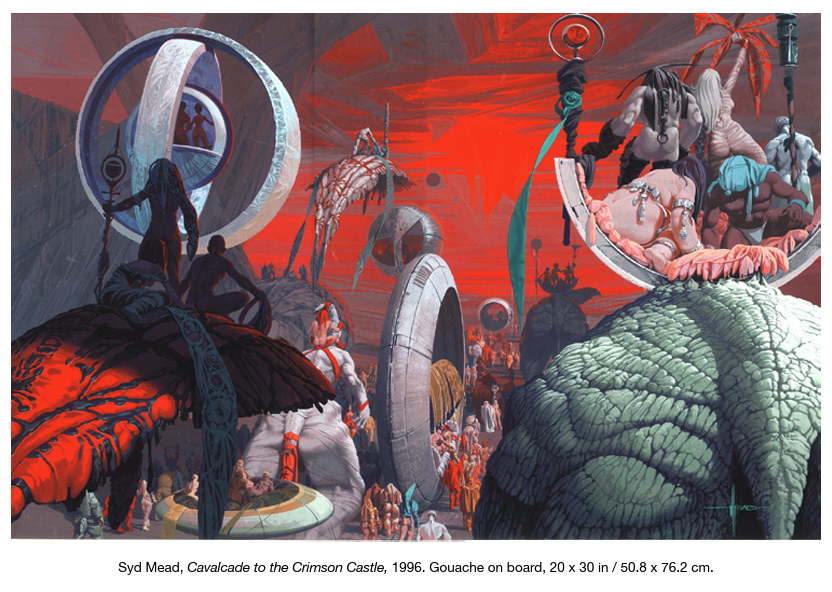
Gouache is a beautiful but notoriously temperamental pigment related to watercolor. And its use is, in part, responsible for the vividness of the work displayed in rare Mead retrospectives such as 1996’s Cavalcade to the Crimson Castle and the more recent Progressions.
“I tell people gouache is French for ‘bitchy medium,’” says Mead. “But I mastered it in school because it has no reflection. It is optically flat.”
Flat is not a word that comes to mind gazing at “Pebble Beach,” a triptych created for the 2000 Pebble Beach Concours d’Elegance. Mead has one of the panels printed on vinyl and installed as wall covering in his sitting room. The sanguine scene is bathed in rich shades of orange, conjuring what Mead refers to as the “Kurisawa Moment,” when the sun is setting and the shadows become dense and soft. There is a “Mechanoid” in the background guarding a muscular woman with high buttocks; a private jump-to-orbit, two-passenger craft is in the foreground, ready to take its owners from the planet surface to their estate in the sky. Nearby is a “Floater,” which is an elaborately conceived future version of a motor home; and, in the far distance, amidst strange foliage and stranger architecture, is a Mercedes logo raised high on a glinting standard.
“It’s a pleasant, romantic scene,” says Mead.
Which is, actually, true of most of Mead’s work. Whether it’s the depiction of a colossal racetrack for mechanical beasts, an idyllic vertical farm, or a future Rolls Royce, the driving force is relationship—the relationship of landscape to light, the relationship of people to landscape, the relationship of people to objects, and, ultimately, each other.
In “City on a Megabeam,” a 1983 painting included in the Progressions exhibit, we find a fantastically detailed extension of a city built up from the ground into the sky like a superhighway onramp. It climbs up over suburbs, water, rock, and scrub. City lights twinkle in the distant flatlands, golden sun reflects in the bay. It is breathtaking view, seductive and emotive, but quiet. In one corner of the foreground, two construction workers stare out from the windows of a site.
Their faces are hidden behind smooth helmets, but their bodies tell a story of watchfulness and yearning. They are separate and eager to return. Their diligence is palpable but so is their aloneness.
‘The best way to predict the future is to create it’ probably had Mead in mind.
This level of emotional richness sits in stark contrast to the cool remove of other artists like Ron Cobb, who have also captured the hearts of science fiction fans around the world. And there is no richer example of it than the work that won Mead his official title as “visual futurist.”
Mead was hired to design vehicles for Blade Runner, but he did what he has always done: he immersed his transportation ideas within a story, and, essentially, painted his way into the movie. By the end, his hand could be felt on everything, from the objects Harrison Ford held to the dripping city streets he walked.
“The movie industry has really changed since then, moving toward one-stop shopping,” says Mead. “As an independent, I might get hired to design one thing, like when they asked me to do the Mask-Maker for Mission: Impossible III, because they wanted something that would look like it could actually work. But usually the same shop does the sets and the props. Blade Runner was different.”
Mead based Blade Runner’s dystopian Los Angeles on the Philippines, and anywhere else objects are forced to live beyond their expiration date. The resulting aesthetic is dense and ramshackle. Layers of jurassic technology are buried under a modern patchwork, with an internal logic that is, at once, completely rational and wholly tied to Ridley Scott’s particular vision of the future.
By contrast, the “Light Cycles” Mead designed for TRON are meant to be computer programs. They are smooth and clean, essentially intuitive computer icons rendered in three dimensions. While his elegant “Solar Sailors,” which traveled along “data transmission beams,” resemble highly stylized dandelion spores, one of nature’s more successful windborne cargo carriers.
Those two movies made Mead something of a sensation in Japan, where illustrators can become rock stars. In the mid ‘80s, he did two big, one-man shows there and sold over 25,000 copies of his new book, Oblagon, in just a little over a month. It wasn’t long before he was doing designs for toys, TV, and anime. Since then, a devoted following has spread around the globe, from Russia to Columbia, and anywhere else people like to future surf.
If we start rehearsing a dismal world, that’s the way we’ll end up.”
Ironically, Mead, whose work extrapolates on the American dream to the nth degree, has been most often disparaged here at home. To some, his shiny vision of tomorrow, where humans and off-worlders are lean, muscular, and privileged; where technology is seamlessly folded into the fabric of society, and human vulgarity and cruelty seem obliterated by the sheer majesty of their toys, seems blindly optimistic and driven by commerce.
Mead doesn’t wholly disagree. Objectively, he once described his own work as “lubricant for capitalism.” It is, after all, largely the result of paid commissions. But Syd Mead still paints the future he wants to see.
“If we start rehearsing a dismal world, that’s the way we’ll end up,” says Mead. “I hope all these dystopian shoot-em-ups are cathartic—I truly hope that’s all they are. In the meantime, I’m doing my small part to visualize a glossy, egalitarian—that means everyone does their part or it doesn’t work—technically advanced society that produces a workable future, and a nicer place to live. That’s what I want.”
 Design collective Numen/For Use was incepted in 1998 as a way for its members — industrial designers Sven Jonke, Christoph Katzler and Nikola Radeljković — to push the boundaries of architecture, design and conceptual art. They've collaborated on everything from furniture design to elaborate installations that invite the viewers to break the norms of how they ordinarily interact with space. Rarely do we see adults take off their shoes to bounce and play, but Numen invites their audiences to do just that. Their latest piece, String in Vienna is an inflatable, bounce house-like structure with an elaborate grid of cords that allow viewers (more aptly, participants) to defy gravity. Their other recent works include a levitating cave made out of clear tape in Tokyo and another inflatable structure with hammock-like netting hung strategically for optimal bouncing in Yokohama, Japan.

 Taisuke Mohri has been drawing since his teens, eventually leading him to study industrial design. It should come as no surprise that he specialized in the design of elaborate objects with visual patterns, elements he now adapts in his drawing work. We previously featured Mohri's realistic pencil renderings of mysterious young people on our blog. He has said that he finds it disturbing when something appears too perfect or real. Mohri's latest works intend to interrupt "perfect" people and creations in nature with smudges and cracks.
