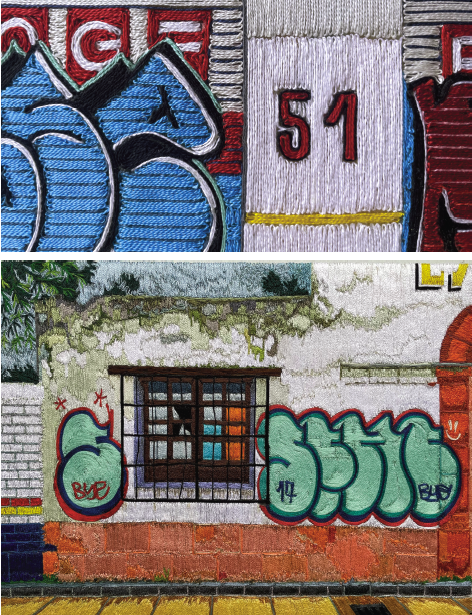
Capturing Cultural memory with the Urban Embroidery of LAURA ORTIZ VEGA
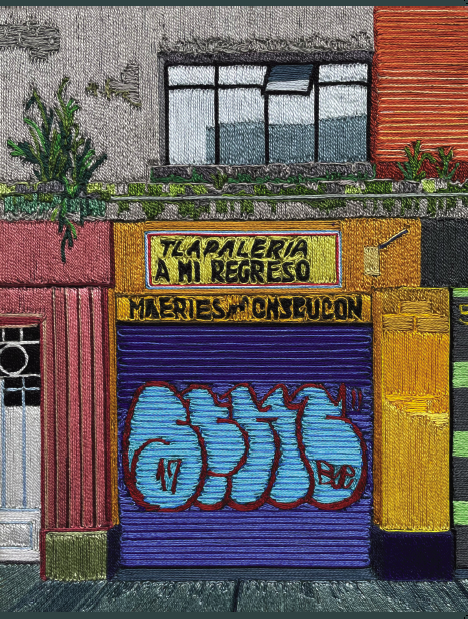
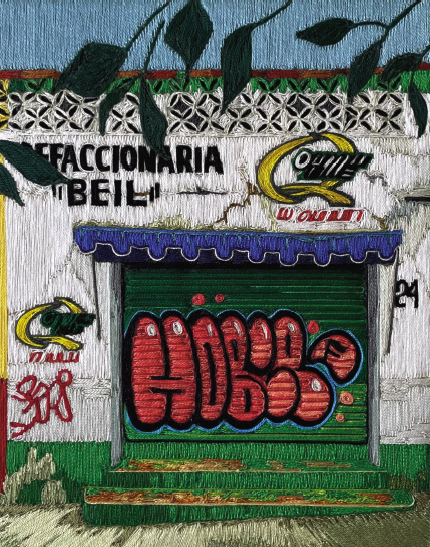
With a creative lexicon featuring yarn, pixels, beeswax, and spray paint, Mexican artist Laura Ortiz Vega has created a new language for herself, one that speaks to the present and the past by using traditional and contemporary techniques, as well as rural and urban sensibilities, to create a body of work that synthesizes all her self-taught skills to communicate a nod to the art and artists working in Mexico. “I want to capture cultural memory. And I am drawn to my landscape; everything is a sense of place,” Vega says. “The main thing for me, as an artist, is to create with my hands. It is a consequence of living in Mexico; we are surrounded by so many artisans and artists, so many vibrant colors, and so many wonderful ideas. It felt like the logical path for me to go.”
Years before she studied industrial design at the Universidad Iberoamericana, Vega says she drew inspiration from the ritualistic yarn painting methods of the Wixárika or Huichol people in Mexico, artists who have spent hundreds of years creating a distinctive style for their textile art in yarn and beadwork. The Huichol work with vibrant colors and distinctive linework to depict visions, myths and their culture’s relationship with nature and deities. These compositions, called nierikas, or “gift of sight,” are placed on sacred yarn boards, called tablas de hilo.
The Huichol art influence stuck with Vega, whatever medium she concentrated on during her creative journey. “I had a friend in high school whose father lived with the Huichol people for two years, and my friend’s house was full of their work, and I have to say, seeing that was very important for me, and my art,” she says. “After I saw their work, I really wanted to create something of my own with my own language and my own way to develop the brush strokes with the yarn. I also so appreciated the rituals, as much as I appreciated the skill and the work that went into these pieces. It was everything about them.”
When she went to university, Vega says she began in woodworking, “but it is a process that takes so many steps to finish something, and sometimes you need machines, and there are many steps to make something the way you think it should be. I love it, but my technique that I use now, it is immediate, whether I paint or sculpt, or I am doing my work with yarn,” says Vega. “One of the reasons I began the technique I use now, is because I am not a great drawing or painting person, and so this was a way for me to do something of my own and create a language of my own.”
I WANT TO CAPTURE CULTURAL MEMORY AND I AM DRAWN TO MY LANDSCAPE; EVERYTHING IS A SENSE OF PLACE …”
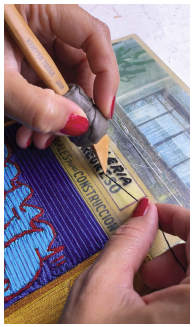
For herself, Vega’s artistic rituals begin when she walks outside each day. “I’m always ready with my cell phone. I look at my catalogue of images and see which ones I want to use. Sometimes I use the photos, and sometimes I draw a reference. I prepare the panel with the reference, then varnish on top of the reference, then place wax over that. Then I use a palette knife edge to press the yarn into the wax. It’s almost like drawing, because it’s a line, but it’s also expanding, because it’s thread. It also feels a little like painting, so it is little of many things, and it’s its own thing.”
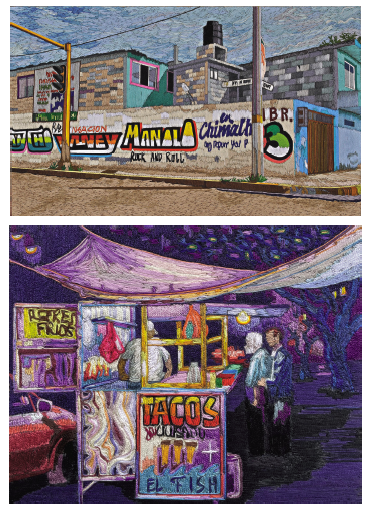
Likewise, Vega’s subjects are representative of both her surroundings, and her own experiences. She draws inspiration from preserving the increasingly fleeting cultural memories she sees in her home of Mexico City, specifically, the graffiti, rotulos (or street sign art), and murals that explode with color everywhere you turn.
“I walk a lot, so I encounter beautiful compositions everywhere. It’s always been a great inspiration to me. All the urban artists are inspiring to me. And it is all ephemeral, which is why I want to capture it.” Vega says she has had a few incidents in which she has taken a picture of some street art, and, the next day, that art is gone, yet, she has preserved it, in her phone, and is then able to bring it back to life in her own compositions.
“It becomes nostalgic for me and helps me keep a sense of place wherever I visit,” Vega says. When asked what street artists she admires these days, she laughs and says there are a number of them “but most of them are anonymous. I know some of them, but many I don’t,” though she adds several of them have seen and appreciated the fact that she has kept their work alive.
THE MAIN THING FOR ME, AS AN ARTIST, IS TO CREATE WITH MY HANDS. IT IS A CONSEQUENCE OF LIVING IN MEXICO; WE ARE SURROUNDED BY SO MANY ARTISANS AND ARTISTS, SO MANY VIBRANT COLORS, AND SO MANY WONDERFUL IDEAS. IT FELT LIKE THE LOGICAL PATH FOR ME TO GO.”
Vega curates an independent exhibition space for artists and artisans in the Colonia Roma section of Mexico City, and that space is now going through a relaunch in 2026. It is very important for her to make sure the art that is shown there is handmade. “I love painting and sculpture and rotulistas. These artists adapt popular imagery to the local context, using a vibrant palette, a Mexican baroque composition, often wrapped with humor, which makes these pieces of popular art one of the core elements that creates a sense of place in the Mexican urban landscape,” Vegas says. “That is my focus with the exhibition space; to show these artists.”
While she works on the exhibit space relaunch, Vega will participate in a show this Spring MISCELÁNEA NACIONAL with Andrés Basurto Portillo at the M5Contempo Gallery in Oaxaca City. That show will include her yarn paintings, plus more, larger, traditionally rendered paintings. Additionally, Vega is applying for residencies around the world in 2026. “I want to take my art everywhere,” Vega says.
This article originally appeared in Hi-Fructose Issue 78. Get the full issue in print here while supporting what we do here.


 Sophia Narrett’s painterly approach to embroidery results in elaborate, startling scenes. Her themes traverse escapism, psychology, and sexuality. Each section of the work brings its own surprising sharpness, with a certain visceral quality resulting from the material.