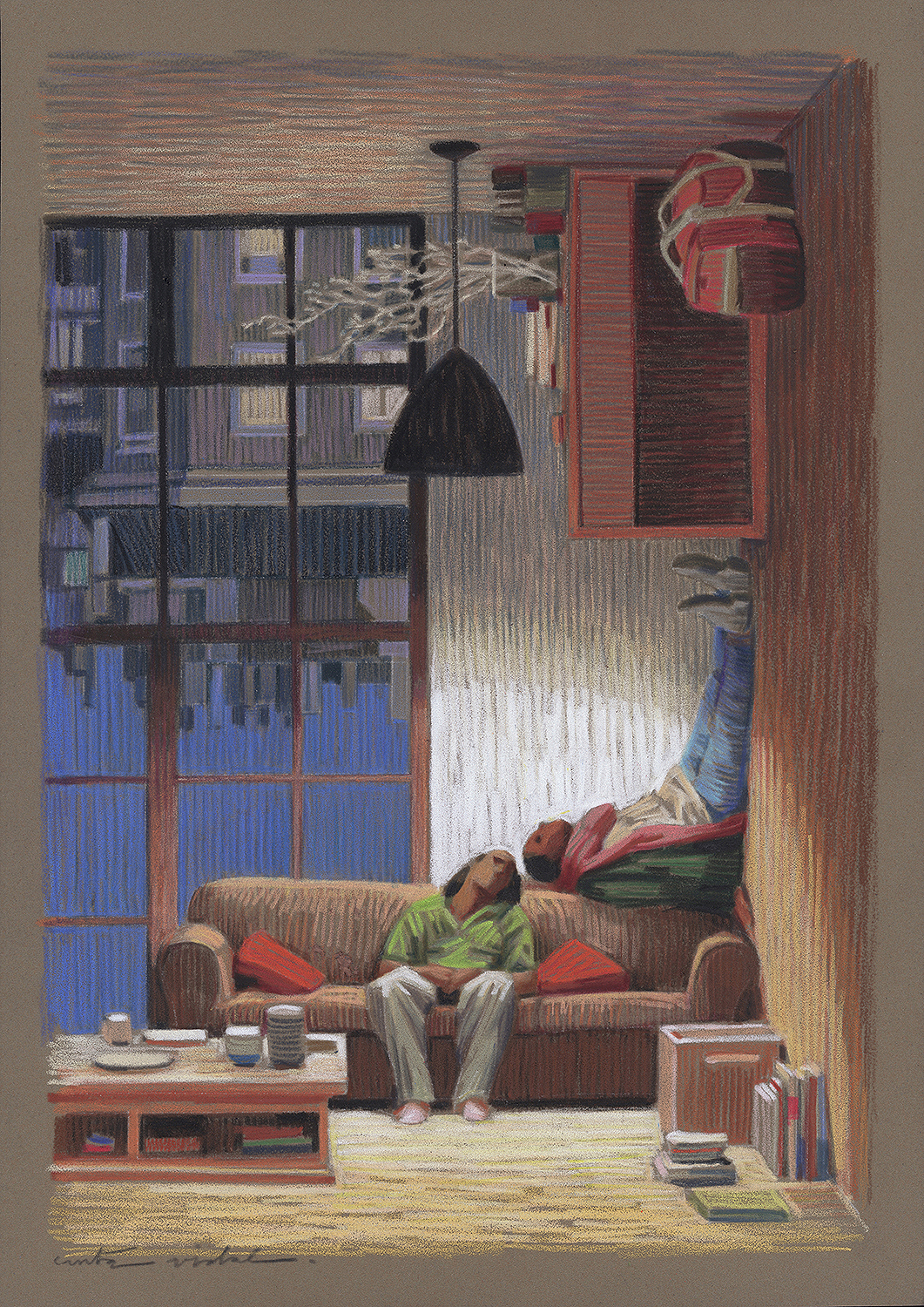
Macro Verse: The Paintings of Cinta Vidal Allow us To Become Gravity-Defying Voyeurs
Above: Cinta Vidal painting a mural for HK Walls Festival, Hong Kong, photo by Ren Wey
This article first appeared in Hi-Fructose issue 68, which is still available in print here. See Cinta Vidal’s latest solo show at Thinkspace Gallery in Los Angeles here!
Cinta Vidal’s intricate paintings often foster favorable comparisons to graphic prints by M.C. Escher, especially the latter’s impossible constructions. Any similarity is largely incidental: Where Escher revealed the subtle harmonies that unite the incongruent, Vidal reaches for something more intimate and human.
“It is a big honor to be compared with Escher,” she says. “His work fascinates me—his mathematical genius, his facility with perspective, the hyperbolic geometry and tessellations. But to be honest, I’ve never tried to copy him. Maybe his upside-down staircases were deep in my subconscious when I started to play with gravity, but it was all toward the goal of expressing my own feelings. I’ve always tried to follow my own path.”
Vidal sees a greater affinity between her work and a ready list of contemporary artists who likewise focus on the relationship between people and their constructed surroundings. Those peers include Ben Tolman, David Umemoto (who has collaborated with Vidal in the recent past), Tishk Barzanji, and Slinkachu.
“We all work with architectural environments,” says Vidal. “For me, this art is about playing with the idea of humanity as a collective. We inhabit these complex spaces that only form a whole when seen from a great distance.”
The core of Vidal’s practice is unpacking the layered meaning of these spaces. Arenas of shelter and comfort—from apartments to fifth-wheel trailers—are arranged like a Rubik’s cube. Boundaries intersect and tessellate until the borders between one space and the next disappear. Wild elements like gnarled trees and weatherworn rocks abut manmade objects in some pieces, but the overall effect is cohesion. Vidal, however, rarely seems interested in critiquing our contemporary way of Western living. Rather, her configurations ruminate on manmade architecture as a cipher to decode the psyche of its residents.

In “Home,” a series of sleek and hovering white platforms are connected by a series of staircases. Figures traverse the staircases, lounge on furniture, and sit on the edges of the platforms, dangling their legs over the edge. Plants dominate the area though, as they too dangle over edges, gather together, and (seemingly) lounge. The living spaces here are set apart from the natural world, yet filled with wood furniture and abounding in plant life. The human figures littered about the scene are dressed mostly in blues and reds that serve to highlight the plants’ verdure.
Pieces like “Home” embrace Vidal’s fascination and overriding interest in the architectures that comprise our human environments. As she explains: “Environments, for me, play such an important role in architecture. In one sense, I am interested in the ways we have used architecture to take care of our more practical needs. There is also that communication between architecture and environment where one informs the context of the other. I love when architecture finds a way to inhabit its location within a natural or wild environment while avoiding an aggressive or overbearing imposition, or, I guess, dominating the conversation. To me it’s about balance. Buildings and nature need to be integrated with each other. That integration, in life and in my art, is a funny game. Each element has its own rules. I’m always surprised with the final shapes of the composition.”
“Together Alone” represents another typical Vidal trope that is, at once, tighter and more expansive in its view of architecture and lived space. Furniture is arranged as a craggy cube that people sit and stand on in various orientations. Everyone on this isolated island of furniture seems calm and comfortable, and proximally close to each other. “But nobody is communicating in that piece,” says Vidal. “I wanted to highlight their aloneness. I wanted to confront the quiet and warm feeling that comes from being alone, but not necessarily being lonely or lonesome.”
Compositions often begin in notebooks where Vidal sketches out first drafts of her paintings. Sometimes those drafts are scanned and traced in ink to be worked from directly. Otherwise, Vidal begins on a blank grid so that she can experiment with the spatiality of an idea. She starts this way, generally, with a single element that is the seed from which everything else slowly grows. As other components are uncovered, she reorients pieces until everything and every figure finds its place and pose. The entire process is marked by improvisation.
These inciting images are typically from her imagination, but occasionally reference real places she encounters on her world travels. “I travel to find new inspirations,” she says. Vidal sketches buildings and landmarks in situ to be fully realized in her studio. Her painting “Tai O” was inspired in this way by a fishing town she visited near Hong Kong.
To me it’s about balance. Buildings and nature need to be integrated with each other. That integration, in life and in my art, is a funny game. Each element has its own rules.”
“Tai O” began with a single building picked from among the sketches she made on the visit. Other elements from the town followed until she had a “crazy-impossible” construction that evoked her experience of the village.
No matter how her paintings come into being, each is designed to create a bespoke experience for the viewer. Vidal says, “I love to highlight the different perspectives we gain from and about our environments. I find the differences between us fascinating, how we can all look at or live in the same place but come away with completely unique experiences. It’s that inner-dimension that I am after.”


Vidal, as such, hopes that her paintings have the opportunity to hang in every possible alignment so that viewers have the chance to see the perspective of every figure. This total devotion to breeding empathy is the foundation of her art. Her prime directive is not creating versatile art, though that is a by-product. The greater concern is in helping people acknowledge that different lived experiences exist.
“We will never be able to see all points of view at the same time,” Vidal says. “All experiences exist all at once, but we only have one set of eyes and one mind through which we can experience this impossibly relative thing we call life. We choose every day how to approach life. The differences are so subtle and obvious at once. In the opposite hemisphere, everyone is upside down from our point of view. And vice versa. We are all just accustomed to this fact, but it is an extraordinary event.”
Vidal chooses to paint her perspectives over wood panels with the grain acting as the backdrop. The woodgrain becomes another character in her work. Lighter woods politely swirl like sand on a gust of wind, while darker varietals might roll behind the image with the ferocity of thunder clouds. “As I learnt from my masters,” she says, “every shadow has a reflection of the surrounding light. When I paint, I use the tone of the wood to paint that reflection. This helps to integrate the architecture and figures firmly in their space.”
Even the most formidable textures provide a mostly neutral base that allows Vidal to blithely play with lights and shades and reinforce the three-dimensionality of her paintings. The play between paint and wood further her concerns about the interactions between the manmade and the natural. The result is harmony.
“Wood panels allow me to paint in a world full of so many textures,” says Vidal. “In my last works, I dyed the base to heighten some aspects of the color while preserving the texture. Mostly, though, I paint on wood because I like the warm and homelike feelings it provokes.”
All experiences exist all at once, but we only have one set of eyes and one mind through which we can experience this impossibly relative thing we call life. We choose every day how to approach life. The differences are so subtle and obvious at once.
Those homelike feelings go back to Vidal’s childhood in Barcelona. There, she grew up in a flat that fills her memories with parquet floors and wooden furniture. That thread continues today, as her current home is filled with a surplus of wood and ceramic, not to mention the fact that she dwells atop her mother’s store, which sells toys made of wood.
“I always tried to flee from urban and synthetic environments,” Vidal says. “It is a family heritage.”
In addition to paintings, Vidal is also well-known for her mural work. Her murals have appeared all over the world, from Spain to Hawaii. These projects incorporate elements of the local cultural context to respect the environment and the people who will view it on a day-to-day basis. Two upcoming commissions will bring Vidal’s work home, with one at the International University of Catalonia in Barcelona, and the other in the public library of Cardedeu, her hometown. Vidal also has a new solo exhibition opening at Beinart Gallery in Australia that will premiere twelve new paintings.
But the project which excites her the most is the possibility of extending her practice into wood sculpture. This will allow her to take on a new challenge while extending her artwork’s mission into a new context.
Vidal reflects: “Working in sculpture would be a continuation of this year’s long exploration, but investigating in an entirely foreign language. I don’t want to paint the sculptures. I want to let their volume be present and speak for itself. I have a very good carpenter accomplice, we already did the first prototype and are really excited to do more!”*
This article first appeared in Hi-Fructose issue 68, which is still available in print here. See Cinta Vidal’s latest solo show at Thinkspace Gallery in Los Angeles here!