


Los Angeles based multimedia artist Amir H. Fallah does not consider our looks to be the most important thing about us. He describes his art as “alternative portraits”, portraits of a person that look beyond their physical characteristics. His 2014 exhibition “The Collected” established his definition of portraiture through a variety of methods from ornate paintings that play with color and geometrical patterns to found-object sculpture. With his current installation “The Caretaker” at Nerman Museum Of Contemporary Art in Kansas, Fallah continues this exploration in new paintings and sculpture.

Fallah chose JCCC journalism professor Mark Raduziner as his exhibit’s main subject, in part because he was a total stranger when the artist started working on the show. This allowed Fallah to fully explore Raduziner’s personality by his unique approach, beginning with archiving possessions such as furniture, articles of clothing, and personal mementos. He incorporates all of these images into his final paintings, which he surrounds with elaborate displays made of those same objects. Here, Fallah found a recurring image in Raduziner’s household cactus plants (his role as their “caretaker” inspired the exhibit’s title) and his collection of lava lamps, which the artist recreated as a 12-foot tall sculpture.

In Fallah’s paintings, Raduziner appears completely covered in his father’s loud Coogi sweaters, framed by cactus-like shapes and other references to his private life. The presentation of clothing is especially important to Fallah who was born in Tehran, Iran where draped fabric provides the wearer with modesty and privacy. It is also the outermost layer with which we first identify ourselves. This seems to be true of Fallah’s art as well, which records people at a surface level, before trickling down to a layered mixture of figurative painting, traditional portraiture, and still life. Just as we get to know someone over time, so does the artist get to know his subject through the creative process. Fallah adds, “I’m taking Mark’s life and making it fit my own artistic needs and wants,” he said. “It’s not a documentary. It doesn’t have to be 100 percent true. It’s a really good metaphor for how history is written – history is constantly being manipulated to suit the selfish needs of whoever is writing it.”


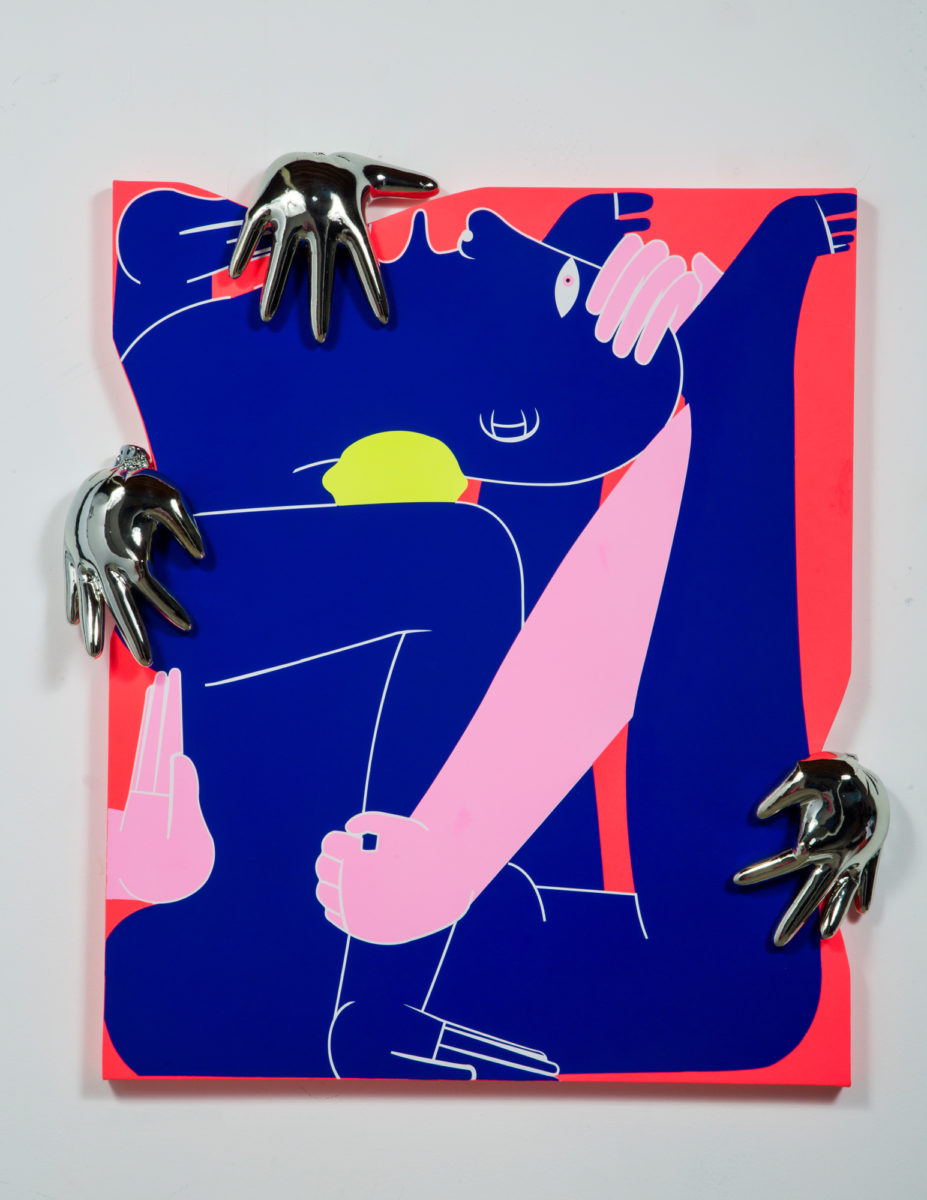 Blending two- and three-dimensional forms, Mark Whalen creates cerebral and absurd arrangements of the human body. Whether stacking vibrant heads or using sculpted hands to sculpt the very shapes of canvases, there’s a metatextual component in tackling the act of creating art itself.
 With "Louise Bourgeois in the
