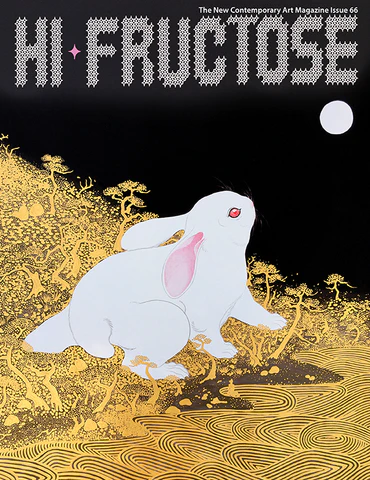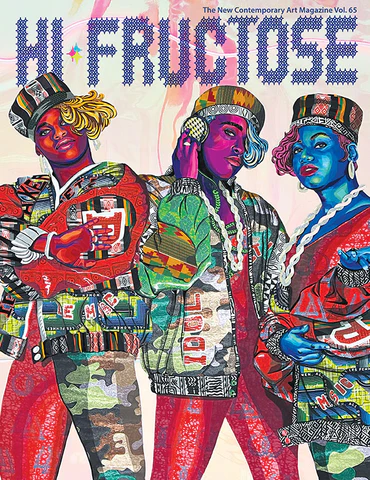
The 76th Volume of Hi-Fructose is here.
The New
Contemporary
Art Magazine
Hi-Fructose is a quarterly print art magazine founded by artists Attaboy and Annie Owens in 2005. Hi-Fructose focuses squarely on the art which transcends genre and trend, assuring readers thorough coverage and content that is informative and original. Hi-Fructose showcases an amalgamation of new contemporary, emerging as well distinguished artists, with a spotlight on awe inspiring spectacles from round the world.
The sometimes two-handed wall drawings of muralist David De Leon would make the late Kim Jung Gi proud.
@deleon_1983 @kimjunggius
The sometimes two-handed wall drawings of muralist David De Leon would make the late Kim Jung Gi proud.
@deleon_1983 @kimjunggius ...
Fascinating art-ifact from the Postal Museum. We need more mail art:
“Some items in a museum collection can remain a mystery, especially if they were donated a long time ago with little back story - just like this postcard.
That doesn’t stop us from being able to figure out parts of the story and piece it together. Or even stop us from appreciating its significance and beauty.
The story of why this postcard was sent back and forth across the Atlantic between Doncaster and Brazil may never be answered. But it’s a stunning and unique item which deserves to be shown.
Video Description:
A protective envelope is opened in the museum archive to reveal a unique postal item. It’s the lid of a cardboard Redbreast branded tobacco box with an illustration of a robin perched on a tree. Multiple messages, stamps and postmarks reveal that it has been sent back and forth between Doncaster and Brazil over the course of several years starting in 1908 and ending about 1919. It is in surprisingly good condition for an item like this over a century old.”
@thepostalmuseum
Fascinating art-ifact from the Postal Museum. We need more mail art:
“Some items in a museum collection can remain a mystery, especially if they were donated a long time ago with little back story - just like this postcard.
That doesn’t stop us from being able to figure out parts of the story and piece it together. Or even stop us from appreciating its significance and beauty.
The story of why this postcard was sent back and forth across the Atlantic between Doncaster and Brazil may never be answered. But it’s a stunning and unique item which deserves to be shown.
Video Description:
A protective envelope is opened in the museum archive to reveal a unique postal item. It’s the lid of a cardboard Redbreast branded tobacco box with an illustration of a robin perched on a tree. Multiple messages, stamps and postmarks reveal that it has been sent back and forth between Doncaster and Brazil over the course of several years starting in 1908 and ending about 1919. It is in surprisingly good condition for an item like this over a century old.”
@thepostalmuseum ...
By Stefan Visan
@visanstefan
•
Untitled
#heart ❤️
By Stefan Visan
@visanstefan
•
Untitled
#heart ❤️ ...
“I feel… like a visual antenna tuned into emotional and cultural frequencies,” Minginowicz said. “Many of those come from the internet, from global anxieties, from algorithmic chaos. I’m a Polish artist in a global glitch. We live in times where reality itself has become surreal. There’s no need to unlock the subconscious—it leaks through our notifications.”
Helena Minginowicz, who uses airbrush to achieve her blurred, then sharply focused pieces, further explained: “I feel like I’m painting archaeological ruins of the present. I’m not just interested in the discarded object, but in the intimacy of its decay—how it touches the body, memory, impulses. These remnants are like cultural fossils: abandoned plastic bags, crushed paper cups, promisingly packaged tissues (I’ve always wondered who designs the embossed pattern on their sides?) …It’s the same with packaging or printed paper towels—I find it deeply moving, this bizarre Sisyphean labor ‘for the trash.’
“All of these disposable objects with short lifespans are not only what we leave behind—they also linger with us, both physically and psychologically. Or they represent what we want to shed quickly, because there are so many new, non-committal things surrounding us. They make it easy to abandon, to consume—especially in the context of relationships.”
Read the full article on @santa___helena by Jessica Tagami, now on Hi-Fructose.
“I feel… like a visual antenna tuned into emotional and cultural frequencies,” Minginowicz said. “Many of those come from the internet, from global anxieties, from algorithmic chaos. I’m a Polish artist in a global glitch. We live in times where reality itself has become surreal. There’s no need to unlock the subconscious—it leaks through our notifications.”
Helena Minginowicz, who uses airbrush to achieve her blurred, then sharply focused pieces, further explained: “I feel like I’m painting archaeological ruins of the present. I’m not just interested in the discarded object, but in the intimacy of its decay—how it touches the body, memory, impulses. These remnants are like cultural fossils: abandoned plastic bags, crushed paper cups, promisingly packaged tissues (I’ve always wondered who designs the embossed pattern on their sides?) …It’s the same with packaging or printed paper towels—I find it deeply moving, this bizarre Sisyphean labor ‘for the trash.’
“All of these disposable objects with short lifespans are not only what we leave behind—they also linger with us, both physically and psychologically. Or they represent what we want to shed quickly, because there are so many new, non-committal things surrounding us. They make it easy to abandon, to consume—especially in the context of relationships.”
Read the full article on @santa___helena by Jessica Tagami, now on Hi-Fructose. ...
Weirdly appropriate post New Year’s mask?
Sculpture by Andy Pomarico.
@andy.pomarico
Jesmonite and wax toast mask
Weirdly appropriate post New Year’s mask?
Sculpture by Andy Pomarico.
@andy.pomarico
Jesmonite and wax toast mask ...
Making Graphite Memory drawings with Tim Biskup. Don’t miss the special insert section we published in Hf 76 on him; we delve into his thoughts on art making and how his home base FaceGuts fits into everything.
@tbiskup
Making Graphite Memory drawings with Tim Biskup. Don’t miss the special insert section we published in Hf 76 on him; we delve into his thoughts on art making and how his home base FaceGuts fits into everything.
@tbiskup ...
We could watch Taylor Mazer’s frisket removal videos all day. It’s like removing a bandage, but with light, but completely different, so I’ll just stop typing. :)
@tlmazer
We could watch Taylor Mazer’s frisket removal videos all day. It’s like removing a bandage, but with light, but completely different, so I’ll just stop typing. :)
@tlmazer ...
In the midst of a long photo session with art model Olive Glass, Laurie Lee Brom noticed the floral dress through a window, laying on a pool table. “That bright, psychedelic thing was just screaming at me,” she says. The reference photos came at the end of the day, just “one more thing” that she wanted to try out with the model. “Immediately, it seemed to work somehow,” she says. “Between Olive being very natural and knowing what I’m trying to do and me having a really clear vision in my head that just hit me.”
She spent about four months painting these images. “What I love is attacking a painting as a puzzle,” she says. “I generally start without a drawing underneath and I just start painting. To me painting is most interesting that way.”
Brom continues, “We all have our own processes, but for me it keeps my mind stimulated to look at it as puzzle pieces. So, a lot of the time, things get super abstract to me as I’m painting them.”
That process lent itself to effects like the rain against the window. “The crazy visual effect that you can get there with the rain and the psychedelic patterns really excited me,” she says. “I loved figuring out that puzzle of how to make the rain work.”
You can read the full article written by Liz Ohanesian, now on Hi-Fructose.
@laurieleebrom
In the midst of a long photo session with art model Olive Glass, Laurie Lee Brom noticed the floral dress through a window, laying on a pool table. “That bright, psychedelic thing was just screaming at me,” she says. The reference photos came at the end of the day, just “one more thing” that she wanted to try out with the model. “Immediately, it seemed to work somehow,” she says. “Between Olive being very natural and knowing what I’m trying to do and me having a really clear vision in my head that just hit me.”
She spent about four months painting these images. “What I love is attacking a painting as a puzzle,” she says. “I generally start without a drawing underneath and I just start painting. To me painting is most interesting that way.”
Brom continues, “We all have our own processes, but for me it keeps my mind stimulated to look at it as puzzle pieces. So, a lot of the time, things get super abstract to me as I’m painting them.”
That process lent itself to effects like the rain against the window. “The crazy visual effect that you can get there with the rain and the psychedelic patterns really excited me,” she says. “I loved figuring out that puzzle of how to make the rain work.”
You can read the full article written by Liz Ohanesian, now on Hi-Fructose.
@laurieleebrom ...