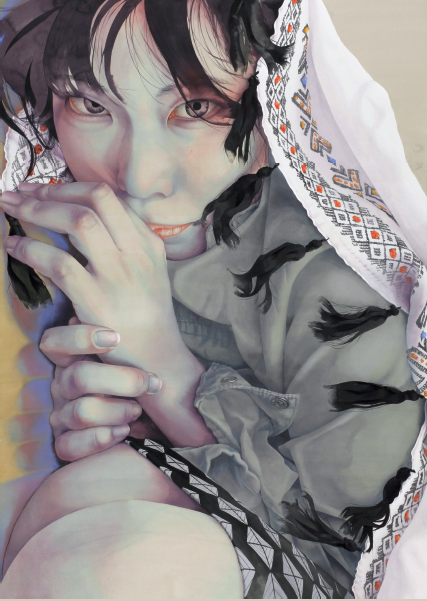
Akika Kurata Explores Hidden Feelings in Her Paintings
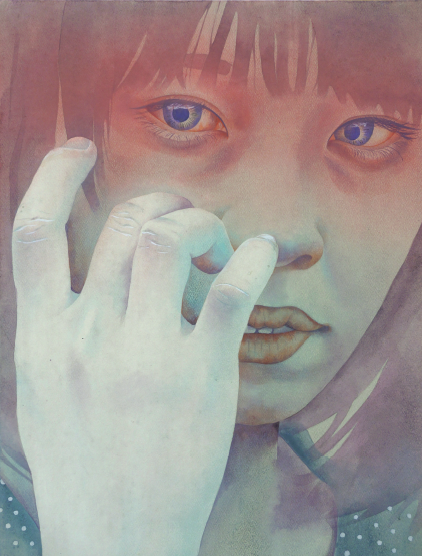
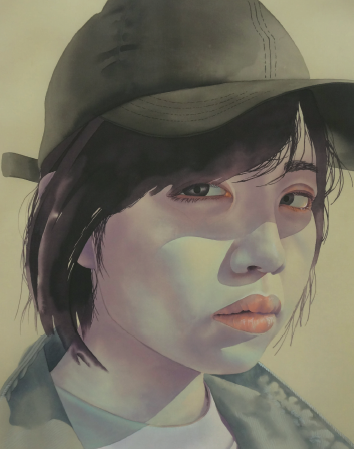
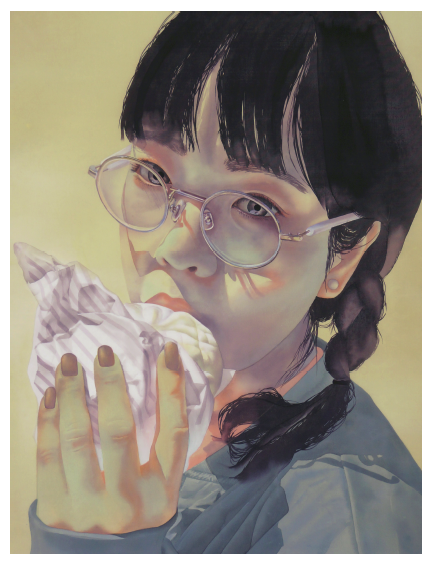
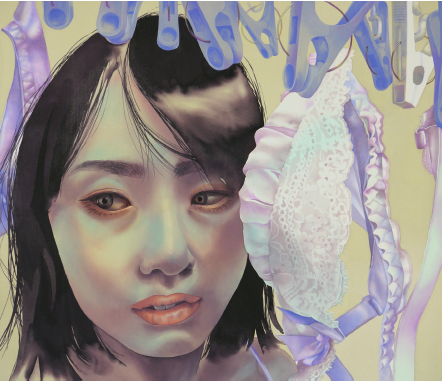
The women look concerned, and weary. They are ready to repel an attack. The women look in love, but bored. “When are you leaving,” they might wonder. The women are only half-present. Matted hair, two eyes, a hand, and the rest have either turned inward or run away. The women are multifaceted. Their eyes are glaciers and their faces a collective mask.
These women are a series of paintings by Japan-based artist Akika Kurata. The models are her dearest friends, portrayed through portraits inspired from within and from without their creator. Kurata says, “Sometimes I will encounter a thought or turn of phrase that feels intriguing. Then I’ll have a friend do a pose of it for a photo. Or, one of my friends will make a facial expression and I’ll snap a photo and look at it, think about it, and figure out why it won’t leave me alone. Then, of course, I might just want to use a new material or color and experiment until the theme and the medium align.”
Whatever the inspiration, the anchor in her compositions is the face and the eyes. Delicately rendered fabrics and emotive hands and telling props come together under a dreamlike light in the single and inexorable purpose of guiding the viewer to the eye. Anything else that feels unnecessary is either cut off at the edge of the frame or dissolved into the yellow-gray background on which all the compositions are suspended. This background works in tandem with the surreal light, crowning supple flesh in floral hues, to unify the paintings and imbue the seemingly everyday models with the essence of the archetypal. A woman with pigtails eating a burger could be Innocence, or Gluttony, or maybe she’s just hungry. Another with a baseball cap could be Envy, or Wrath, or perhaps on the verge of sneezing. The subjects are given room holistically to grow, evolve, and be atavistic.
This sense of an arc is vital to her process. Novels and stories, she says, are better suited to foster the mood she needs to conceive her images. “I have my favorite artists and artworks,” she says, “but maybe they aren’t my inspiration. Stories and my friends are my best for that.”
I wanted to find a way to express the feelings I know, that I’ve lived and can understand and fully empathize with…”
Visualizing the feelings that people try to hide is an ultimate goal of Kurata’s art. The glistening and gleaming eyes of her subjects betray hints of competing emotions. The viewer encounters them at the moment of sudden realizations. Looking inward, they survey the destruction left by a well-intentioned act gone awry alongside dreams that have been put aside in the face of the pressing, prosaic concerns of daily life. Whether they gaze into the distance or directly into the viewer’s eyes, the women of Kurata’s portraits concurrently scan within for a glimmer of hope.
“I want to explore the sensitive and complex parts of a person,” she says. “It’s the dangerous feelings that attract me to a composition, the unspoken emotions that arise within me or that I find simmering in a subject. Sometimes, the feeling I want to draw comes across as too dark and grotesque. It’s about balance.”
The spark that implored Kurata to explore such hefty subject matter first flared in high school. Before that, art held little attraction. “In my childhood,” Kurata says, “I wasn’t that interested in drawing.” The manga and anime so very popular among her peers was a natural and early intervention that demonstrated how art could foster interpersonal connections and introspective growth. She started doodling and making her own art and, by high school, was determined to refine her passions into a creative vision.
I want to explore the sensitive and complex parts of a person,” she says. “It’s the dangerous feelings that attract me to a composition, the unspoken emotions that arise within me or that I find simmering in a subject.”
Looking back, Kurata feels like she was searching for a sense of purpose that art fulfilled. She says, “Maybe I wanted to find a dream that I could work at, that I could build on and grow in as a life’s work.”
This attentiveness to personal growth informed an early and important aesthetic choice vital to the direction of her art today. In 2013, she made a portrait of her grandfather. Despite the tenderness she felt toward the subject, something was off. The subject’s essence was missing. He was there, expertly captured in profile. Light caressed his balding pate and traced his wrinkles and just caught his chin. The grisaille composition was as lifelike as a photograph. But he neither thought nor spoke, he simply existed. Kurata realized that she stopped at rendering an image of her grandfather when she needed to push forward and connect with his experiences and memories. Love was not enough to foster the bond between artist and model. So, she searched for a subject that could leave her fascinated, that could fill her with awe.
Using her friends as models bridged that gap of true intimacy. “I wanted to find a way to express the feelings I know, that I’ve lived and can understand and fully empathize with,” she says. Many of the models she has turned to over the past few years are close friends aged eighteen through twenty-five. Depicting that period in a person’s life is fruitful, Kurata believes, because of the pressures and decisions that come with the transition from youth into adulthood. In the quiet moments, spent at the park or on errands or in a living room, she finds the deeper truths in the things left unsaid—their sadness, melancholy, and pain. Usually, they are going through trials to which Kurata also relates; so she feels these experiences should be documented for others to witness.
“The reason I’m drawing women is because I’m a woman too. Nothing more, nothing less.”*
This article originally appeared in Hi-Fructose Issue 45, which is sold out. Support what we do and get a new Hi-Fructose subscription here.
Though the starting point of his work stems from complex ideas surrounding our perception of reality, Bruno Novelli makes these intellectual concepts an afterthought in his candy-colored abstract paintings. His work gives visual pleasure first and foremost. Novelli (who sometimes playfully stylizes his last name as 9li) recently presented a new series of paintings titled "Materia Radiante" at David B. Smith Gallery in Denver.
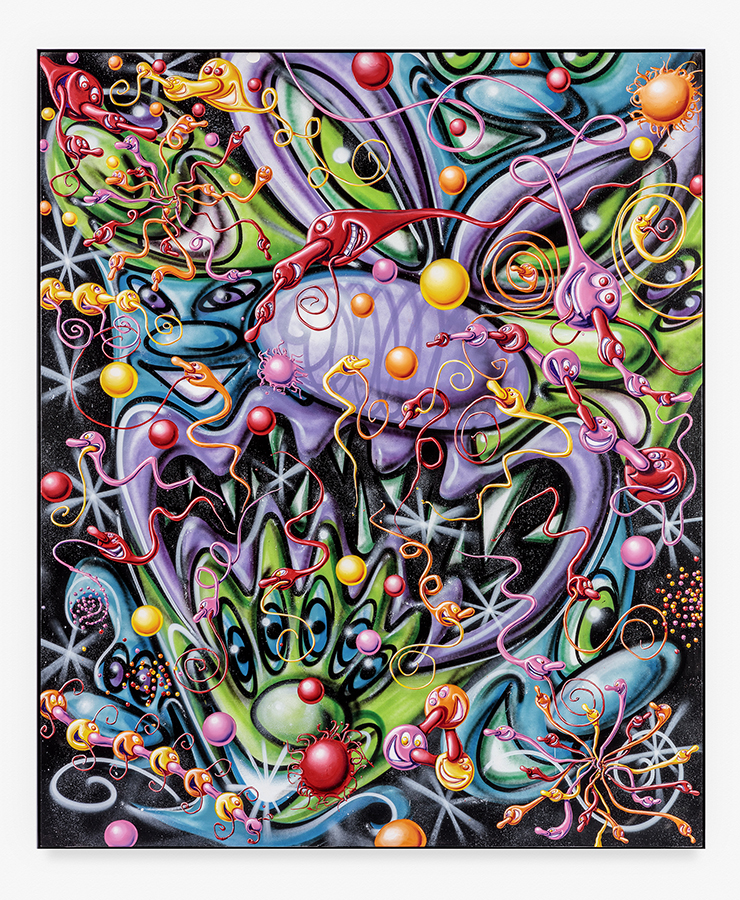
In his current show at Honor Fraser in Los Angeles, Kenny Scharf shares wild new works that include new mixed-media paintings, sculptures, assemblages, and more. “Optimistically Melting!” takes over the space through Nov. 16, and in it, viewers find an veteran artist who maintains his graffiti sensibilities yet constantly pushes his interests into new arenas.
With "Dimensionality," Jen Stark's vibrant sculptures, paintings, and installations take over Joshua Liner Gallery with her illusionary talents. The show, which began this week and runs through July 19, features both analogue and digital elements to activate the New York City space. Stark was last featured on HiFructose.com here.
In Adele Bessy’s crowded paintings, figures and faces are used as building blocks. Her work, in both its frantic quality and control, has been compared to the likes of Bosch and Arcimboldo. The artist is based in Achères, Ile-De-France, France.