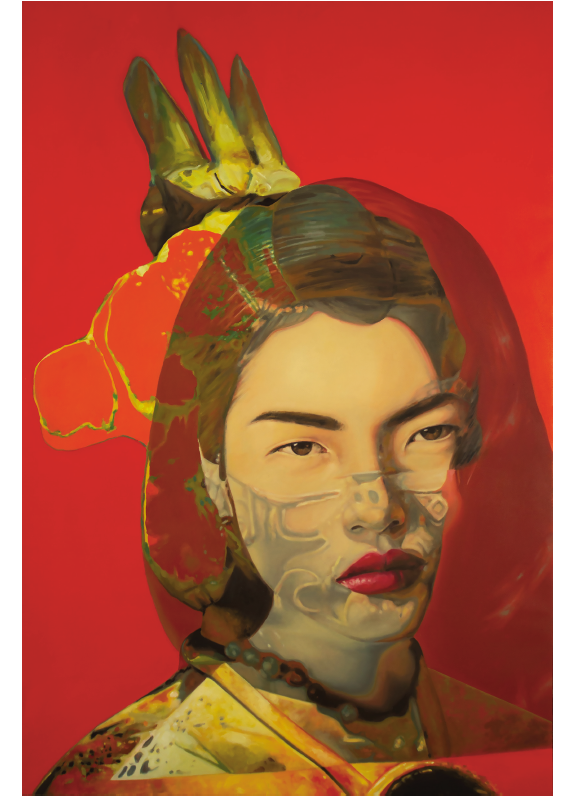
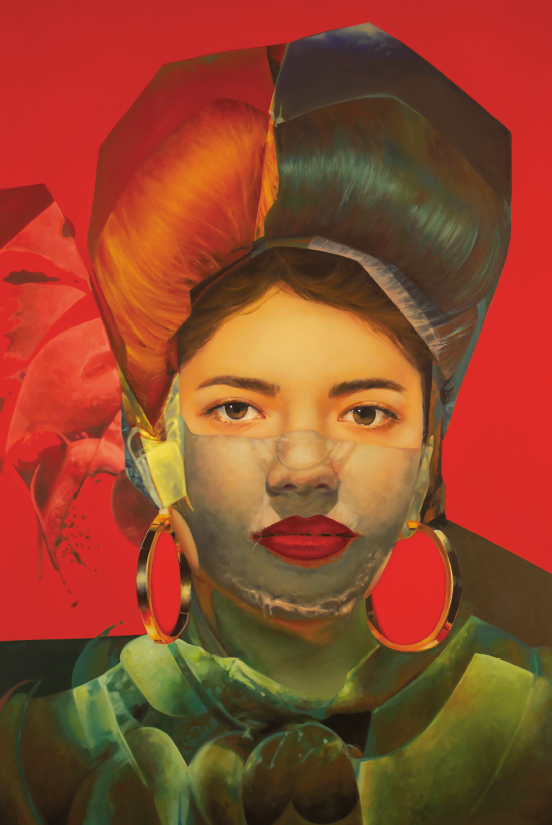
In the “feminist west” that lives on Jennifer Nehrbass’s canvases, women ride horseback and hike in fashionable attire. They appear in head-and-shoulder portraits against fiery backgrounds and nude in pieces where figurative and landscape painting converge. In her work, Nehrbass challenges the common depictions of the U.S. West. “You would always have the man who came out—could be Spanish, could be English—conquering the West, taking land and they would have the landscape, kind of like a Bierstadt painting, to romanticize the West,” she says.
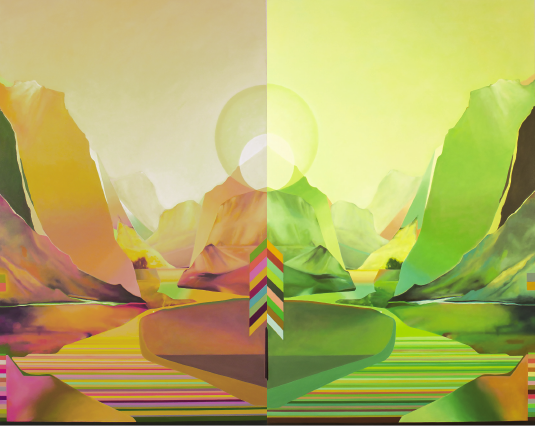
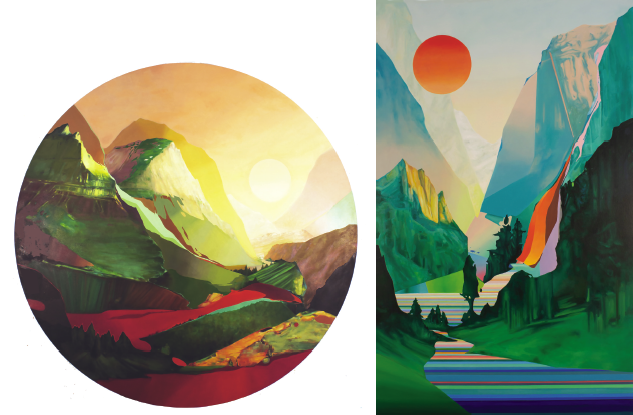
Nehrbass’s art follows three different tangents. There are her portraits, which include series like “Feminist West,” “Womenfest Destiny” and “Pioneer Project.” Here the characters sometimes (but not always) interact with a fictional landscape. Her landscape paintings, which come together under the series Punk Mountain, depict broad expanses of land without a person or animal in sight. Though the isolated, mountainous spaces she paints look like they could be the American Southwest, they too are depictions of places that don’t exist. “The landscapes are completely contrived,” she explains. “There’s nothing that’s specific to a certain place.” Then, there are Nehrbass’s sculptures, which she makes out of wood found in the arroyo near her home in Albuquerque. To an extent, there is an interplay between the landscapes, portraits, and sculpture in her overall body of work. “They have to do with a little bit of reflection on where I live,” says Nehrbass. “The intrinsic value of the landscape is really big here in New Mexico, in its history. I think that all of these things are elements that I’ve incorporated into both the figurative work, the landscape, and the sculptures.”
A former textile designer for Ralph Lauren, Nehrbass’s familiarity with design and fashion does manifest in her paintings, particularly when it comes to color. “There is this element of thinking through balance and harmony of colors and things like that that you would find in design,” she says. “I definitely love fashion photography. Sometimes, I’ll try to use different elements of how they use lighting and things like that. I love textiles. I love painting textiles and things like that.”
SOMETIMES, WHEN YOU’RE HIKING, YOU GO OVER ONE BIG HILL AND THEN THERE’S MORE TO GO, SO I LIKE THAT ASPECT OF CONTINUING, MAKING A PATH OF A JOURNEY FOR PEOPLE …”
Both the portraits and landscapes often begin with collaging images that Nehrbass finds online. “I like finding imagery that anyone else can find,” she says. “I feel like I’m using images that are already out there. I’m not over-curating by doing my own photography.”
Her portraiture veers towards photorealism, at least when it comes to the subjects’ faces and hands, and that’s an important component to Nehrbass’s work. “I utilize that as a way to push the figure off the background because the background can be a little more gestural or things like that, or just solid black, as some of the paintings are,” she explains. “It does create a contrast as if this person is performing in front of people. It’s almost like a set to me that this character is in. Making one a little more realistic than the rest makes that a little bit more evident.”
“It also becomes really boring for me as a painter to do all this realism and doing everything realistic in the background,” Nehrbass adds. “There’s a play in paint that’s kind of fun. Painting has language, there could be a solid area that can represent pop art and then you have a realistic figure, which is more a reference to photography and then you have this gestural background. I like those different languages of painting within one.”



 Portland, Oregon-based painter Jeff P. (who goes only by his first name and last initial) remixes traditional scientific illustration techniques to create psychedelic images inspired by nature. Home to Native American peyote ceremonies and multitudinous wildlife species, the southwestern desert has always been a site of escape and self-discovery in the American psyche. Jeff P.'s colorful, surreal paintings of snakes call to mind these connotations. While his early work resembled flash tattoo designs, his latest paintings utilize the ornate patterns of various snake species to create colorful, dreamlike designs.
 Born in Philadelphia and raised in Fresno, Luke Chueh (featured in HF Vol. 24) has gained much notoriety in Los Angeles art scene with his colorful, illustrative paintings. His upcoming exhibition “Self-ish” at CHG Circa in Culver City, is the latest continuation of Chueh’s stand-out style. A cast of playful-looking characters, the adult world that they live in and the dissimilarity between the two is a primary theme of the 20 new pieces Chueh will have on display. "My work is an illustrative exploration of visual and narrative contrast" Chueh said describing his work.
