Menu
The New Contemporary Art Magazine

The Paper Art of Christine Kim

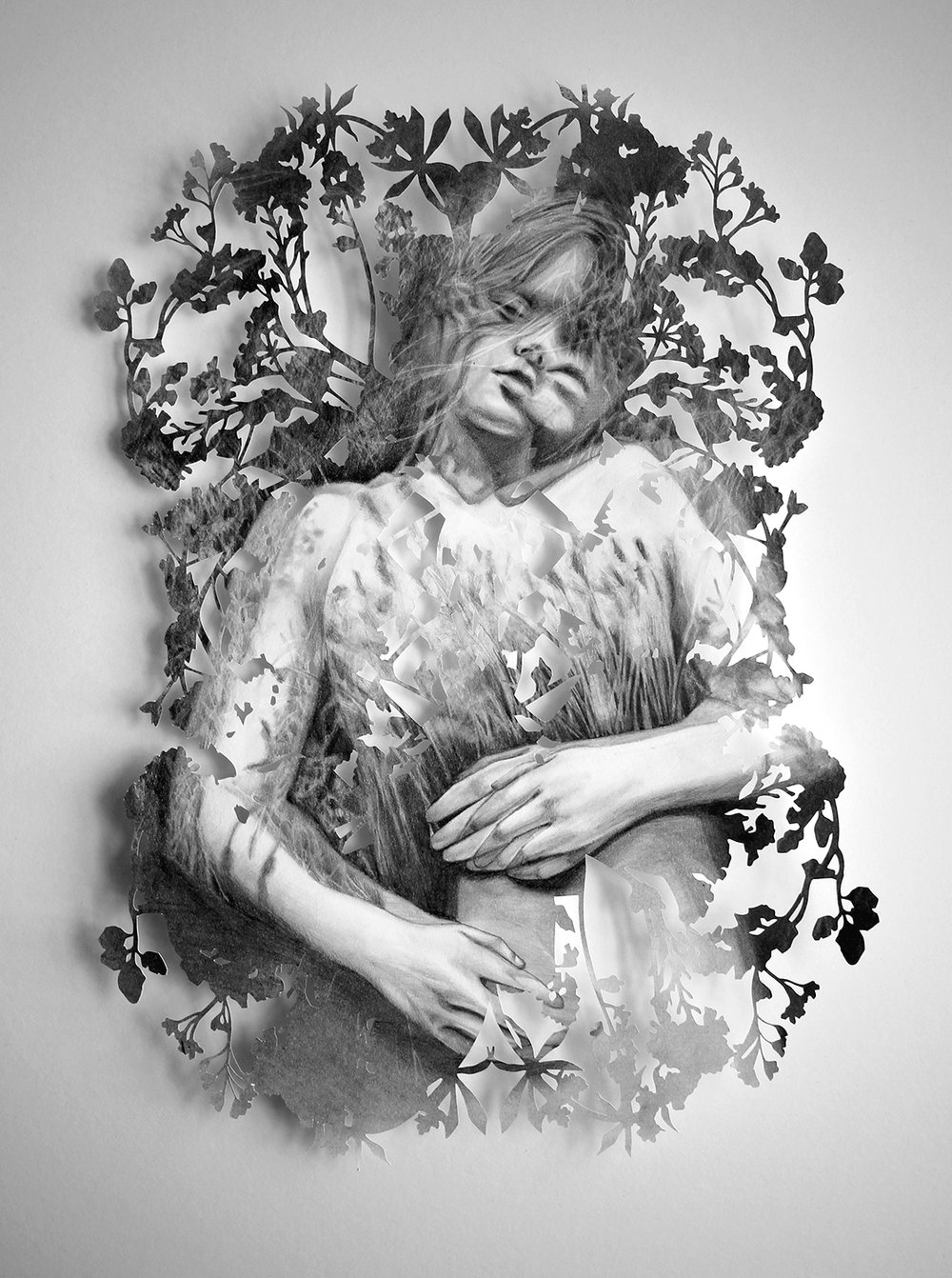
Christine Kim's practice is a blend of painting, drawing, and sculpture. The Toronto-based artist’s experimentations with layering and cutting works moves between both graphite drawings and painting. Each carry ghostly notes, each offering their own considerations of negative space.

Christine Kim’s practice is a blend of painting, drawing, and sculpture. The Toronto-based artist’s experimentations with layering and cutting works moves between both graphite drawings and painting. Each carry ghostly notes, each offering their own considerations of negative space.

“I like to start each collage with a gesture that I’m drawn to,” she says. “What I look for in a body is the architecture of the gesture, the stillness of a pose and an atmosphere of quiet. In my earlier collages, the process was divided between drawing, painting, and cutting. All of these processes were done without much consultation between each other. Instead it was about gathering ingredients of mass and line in order to experiment with the assembly of each collage. I enjoyed this a lot although it became really messy. I worked on the floor quite often because I would run out of desk space, so my studio became islands of compositions.”

Find more of her work on her site.

Meta
Share
Facebook
Reddit
Pinterest
Email
Related Articles
British artist Joe Fenton infuses his immensely detailed graphite and mixed-media drawings of interplanetary iconography with inspiration from religious artifacts from centuries past — the ornate frames of gilded Orthodox icons, Tibetan Buddhist altars with their elaborate wood carvings. East and West come together in these large, fantastical works. Fenton is an award-winning children’s book author and illustrator, but his personal work tackles heavier topics. The artist says that much of his drawings explore the idea of death, namely the fear of death — an anxiety many appease through religion and spirituality. Fenton’s baroque, intense scenes are cramped with hellish visions and strange spirits, densely filling each page with deities and demons from a fantasy belief system rife with occult symbols.
The acrylic paintings and drawings of Cristòfol Pons are visions of converging realities: past and future, art history and something otherworldly. His characters and visual motifs, though consistent throughout his work, point in varying directions. As he’s said, “The present is just a moment that vanishes at every step, the past is a blurry haze and future a horizon longing to fade.” He will at times point to the recognizable, perhaps a piece by Jeff Koons or a historical icon, yet only as a point of entry into something else entirely.
New York-based artist Ian Ingram uses primarily charcoal and pastels to render rich self-portraits filled with details normally almost invisible to the human eye. Ingram focuses his energy on the copious details in the skin, rendering the texture of each pore and pockmark. He uses primarily dark tones for his work, allowing the skin's texture to glisten as if reflecting the sun's rays at its lowest point just before it sets. While some of the portraits focus on the poignancy of the facial expression, others include surreal details such as embroidered geometric patterns. By way of subtle cues, Ingram's drawings communicate the nuances of our emotions and imaginations.
Israeli artist Zemer Peled uses slivers of porcelain to emulate shapes and forms of the natural world, from feathers to leaves and petals. The result is something otherworldly, blending hues and patterns for something both familiar and strange. The delicate and organic constructions defy their actual sharp, hardened nature. These works come in differing sizes, from the size of common houseplants to towering over viewers, all made from thousands of pieces of porcelain.

Subscribe to the Hi-Fructose Mailing List